Showing posts with label Europe. Show all posts

Wednesday, September 24, 2014

DNA Mysteries: Iberian R1b-V88 in Africa

   When I first heard about R1b in Africa, my immediate assumption was that the predominantly Celtic haplogroup must have been a recent transplant.  I ran some of the V88 haplotypes against the big databases (FTDNA & ySearch) expecting to see matches to European men within the African colonial timeframe.  It wasn’t that easy.  Common ancestor analysis put the R1b Africans (V88) thousands of years removed from the rest of their European R1b cousins.  Where did they come from?  How did they get there?


   I started with the given that the R1b defining mutations (SNPs) occurred in the Iberian Peninsula.  The jury is still out on this hypothesis.  There have been scientific papers for and against Iberian origins of R1b.  My own work (Iberian Origins of R1b) supports an origin prior to the Neolithic expansion.  Could V88 have made a straight-line migration from Iberia to the Lake Chad region of Africa?  Could V88 have crossed the Straits of Gibraltar, travelled across the Sahara, which 7,000 years ago was a savannah well populated with animals for hunting, and arrived at Lake Mega-Chad?  That was my early premise.  I was wrong.

   The distribution of V88 is much larger than any of the scientific papers would indicate.  While I agree with the work that’s been done correlating the spread of V88 with the spread of Chadic languages (Cruciani et al 2010), the Chadic population is only a subset.  Nobody takes into consideration the V88 populations in Europe and the Middle East.  If they do, it is a sideways glance to say were ignoring them because they don’t fit into what we are trying to prove.  If you don’t look at the entire picture, your conclusions will be skewed.

   I wanted the largest selection of V88 Y-DNA records with at least 37 markers tested.  I started with Family Tree DNA projects that had the records SNP tested.  Those haplotypes were run against the ySearch database to identify highly related records with no SNP testing.  The initial gathering of records picked up individuals with SNP M73.  These were removed.  The key differentiator between V88 and M73 was DYS464a&b.  V88 was typically 12,12 and M73 was 15,15.  Thirty-seven or more STR markers are helpful in identifying additional related haplotypes and even more necessary in determining the relationship between records.  Most studies only looks at SNPs or a small handful of STR markers.  This is shortsighted.  Imagine a reference population of 100 records all with the same SNP.  Without enough STR markers you can’t tell whether you are looking at one haplotype with minor 1 or 2 step variations or 100 unique haplotypes.  That’s the difference between a founder event starting with as few as one individual or a group with greater diversity and age.

   My final set of 119 records has at least 37 STR markers, V88 SNP testing or is highly related via STR and has the geographic location of the most distant known ancestor.  The records are processed through PHYLIP to generate a phylogenetic tree.  The phylogenetic tree give a visual depiction of the relationships in the dataset and an approximate number of years back to common ancestors, represented as the nodes between the records.


All of this is very standard genetic genealogy.  I add a twist (Biogeographical Multilateration) by converting the years back to a common ancestor to a distance using Cavalli-Sforza’s migration rate of 1 to 1.2 km per year.  This is enough for me to solve a series of cascading equations giving me the locations of the common ancestors.  Looking back at the phylogenetic tree shows us how all the nodes and locations are connected, essentially the flow of migration.


   The out of Iberia event took place about 7,700 ± 1,600 years ago.  TMRCA calculations have been shown to be very inconsistent.  Some folks use a constant mutation rate and some use rates per marker.  I include a TMRCA to give a relative chronology.  While the majority of R1b is known for its Western Atlantic migrations, V88 took a path along the Mediterranean coast and down the Adriatic.  While none of the V88 records indicated Crete as an ancestral location, it appears multiple times as a common ancestor location.  The data shows Crete as a stepping-stone in the Mediterranean as V88 migrated to the Nile River Valley.  The back to Africa event(s) occurred roughly 5,500 ± 1,000 years ago.


The majority of the Chadic records (Cameroon, Chad and Nigeria) have relatively close genetic connections to individuals in the Middle East (mainly Saudi Arabia).  The Chadic and Middle Eastern records tie back to common ancestors along the upper Nile.  There is a significant lack of information to understand what impact R1b-V88 had on the Nile Valley cultures.  Considering that there was only 1 out of 119 records with an exact Nile River location, I would venture a guess that V88 didn’t integrate well.

   While the V88 back to Africa migration has captured much attention, the data shows a more fascinating event.  There was a V88 re-migration back to Europe from Africa.   The back to Europe event took place about 3,200 ± 1,000 years ago.  Again, Crete played a role as a stepping-stone as V88 entered the Eastern Adriatic region and spread into Central and Eastern Europe.  Someone will probably notice that many of the V88 in Eastern Europe are Jewish and that the date for leaving the Nile region is close to the time of Exodus.  There is nothing in any of the data to indicate that this was the Jewish Exodus from Egypt.  The V88 group in Eastern Europe is closely related and there is phylogenetic evidence to support that this may have been a founder event with a single male or small group of closely related males.  There is no evidence to support that those founders were Jewish when they left Africa.


   By looking at the big picture, including all the data and letting the data illustrate the patterns, we can unravel what appears to be the mysterious appearance of R1b in Central Africa.  Along the way, we can uncover a previously unknown re-migration from Africa to Europe.  Too often haplogroup data is treated as discrete buckets of information living in a vacuum with no interaction to other haplogroups and no internal relationships.  Every DNA record is connected to every other record in a network.  Each haplotype is a vector with location and direction.  The sooner we treat genetic records as a network analysis, the sooner we will solve more DNA mysteries.

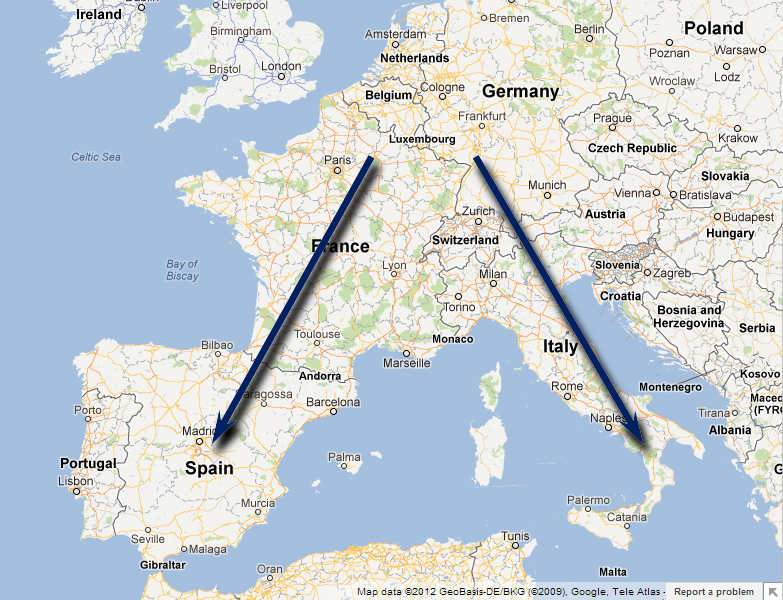
Out of Iberia and back to Africa.  Followed by a return to Europe.

Reference:

Maglio, MR (2014)  Y Chromosome Haplogroup R1b-V88: Biogeographical Evidence for an Iberian Origin (Link)


Tuesday, August 12, 2014

Iberian R1b Y-DNA: First Movers in Europe

   The disputed origins of haplogroup R1b, most commonly thought of as Celtic, remains split between Iberia prior to the end of the last ice age and various West Asian locations after the ice age.  A new view on the R1b homeland comes out every year.  With all we know about DNA, shouldn’t we be coming to a consensus?  Typically, I refer to R1b as Celtic to help an audience make the connection between lettered haplogroups and culture or ethnicity.  I also add the caveat that Celtic is a misleading label.   R1b is supergroup of cultures including; Iberian, Gallic, Celtic, Germanic and Scandinavian.  To attribute empires or nationalities to R1b would be foolish, as R1b is tens of thousands of years older than any known empire.

   Perhaps I’m naïve.  I like simple, logical answers.  The earliest publications on R1b described their ancestor R1, entering Europe from central Asia during a warm period about 30,000 – 40,000 years ago.  The last ice age forced R1 to split and take refuge south in Iberia and the Balkans.  Time and separation gave us the mutations R1b in Iberia and R1a in the Balkans.  That split is roughly what we see today in those regions.  That’s clean and simple.  The real world is much more complex.  R1b and R1a were not alone in Europe.  Their interactions with the other major European haplogroups- E, G, I, J and N has to be taken into consideration.  We can’t analyze R1b as if it were in a vacuum.

   Let’s take y-DNA haplogroups out of the picture for a moment.  We know that modern humans survived and flourished in the Iberian refuge during the end of the last ice age, based on mitochondrial DNA studies.  [Could someone please run some y-DNA tests on those samples?]  The tribes in western Europe, whoever they were, had a 1,000 to 2,500 year head start over the tribes in central and eastern Europe on repopulating the continent.  The ice sheets melted and retreated earlier on the west coast than in the rest of Europe.  This gave the inhabitants of the Iberian refuge an advantage – a “first-mover” advantage gained by being the first to move north.  These first-movers gained a land-monopoly.  A tribe with a first-mover advantage and over a 1,000 year head start should have been hard to displace from western Europe.  In other anthropological situations, those original inhabitants are forced into niche locations by invading populations, but very rarely are displaced completely.  What we see on the west coast of Europe, is a very strong R1b presence and no niche haplogroups of a significant age.  From this point of view, either R1b is the original Iberian inhabitant or R1b completely decimated another earlier haplogroup that had a 1,000 year geographical head start.  I like simple.  R1b was in Iberia first.
   Let’s throw some data at the problem.   The R1b haplogroup population is enormous.  The majority fall into SNPs R-P312 (Celto-Iberian) and R-U106 (Celto-Germanic).  There is so much information there that it tends to be noise.  If you want to get to the root of R1b (R-M343), you need to work with the branches that are closest to the root - R-L278*, R-V88, R-M73*, R-YSC0000072/PF6426 and R-L23.

• • R1b   M343
• • • R1b1   L278
• • • • R1b1a   P297
• • • • • R1b1a1   M73
• • • • • R1b1a2   M269
• • • • • • R1b1a2a   L23
• • • • R1b1c   V88
[• • • • • • • • • R1b1a2a1a1   U106 - too far downstream]
[• • • • • • • • • R1b1a2a1a2   P312 - too far downstream]

   I collected 250 records that matched these SNPs or were genetically close by STR haplotype.  These records were mapped based on user-reported most distant ancestor location.


   This is not a connect the dot exercise.  Just because two or more records appear geographically close doesn’t mean that they are genetically close.  These 250 records have to be treated like a network.  If this were Facebook, these folks would be randomly associated through family, business, school or neighbor connections.  These are y-DNA records.  There is a relationship between every pair.  Each pair has a different common ancestor, with a different number of generations to get back to that ancestor.  Here is an example of what that relationship looks like across multiple pairs.  The number represents years back to a common ancestor (TMRCA).


When all of the interrelations are taken into consideration, the group of records can be displayed as a relationship tree of who is older or younger and who is more closely related to whom (phylogenetic tree).


   Now we have who, where, when and how the records are connected.  At this point it does become a connect the dots exercise.  I’ve used a biogeographical analysis to connect very specific sets of dots based on the calculated interrelation of the entire group.


   The R1b genetic family tree has a trunk and many branches.   The trunk of the R1b data is firmly rooted in Iberia.  The main core of the tree stretches along the western Atlantic coast of Europe and branches across Europe and even back into Asia.  The results that I found support the work of the earliest pioneers in the field and conflict with the latest publications.


   Every analysis has its limitations.  The work that I’ve done looks back at the R1b family about 8,000 years.  The scarcity of data only allowed for me to predict the origin of R-L278, which is currently one branch below the main root of R-M343.    I can’t tell where R1b was between the times that R1 split into R1b and R1a, yet.

   In my analysis, I have included R-V88.  They are a curious group of R1b found in Africa and the Middle East.  I will be treating R-V88 in a separate write-up to do justice to a very interesting back migration story.  The R-V88 article can be found here.

Reference:

Maglio, MR (2014)  Biogeographical Evidence for the Iberian Origins of R1b-L278 via Haplotype Aggregation (Link)

Friday, September 21, 2012

Vandals DNA: Leaving Genetic Graffiti Across Europe


   I have been fascinated by barbarian history since my sixth grade Social Studies teacher, Mr. Rose, handed me the textbook on the subject.  I still read everything I can on the topic.  The biggest draw is the mystery of where each tribe came from, appearing out of the shadow of mythology and for many, disappearing into obscurity.  I’m finding that DNA can help answer the questions of ‘Where are they now?’ and ‘Where did they come from?’

   The word barbarian is first seen in the Greek language as barbaros.  One possible origin of the word is that it was coined from the sound of the language used by these nomadic tribes – ‘bar bar bar’.  The Vandals (Vandali) appear in the history books as early as 166 AD and are described as an East Germanic tribe.  The theories on their origins include having Scandinavian roots in the parish of Vendel, Sweden or Germanic roots with a connection to the word meaning to wander (wandeln).

   Even if the Vandals’ name wasn’t derived from the word wandeln, wandering was what they did the most.  Perhaps chased is a better description.  Around 300 AD, the Goths fought with the Vandals and pushed them west along the Danube River.  By 400 AD, the Huns pushed the Vandals further west to the Rhine River.  At the Rhine, the Vandals fought with the Franks, won and moved into Aquitaine (western France), pillaging and plundering the whole way.

Historical Vandali migration

   I’m reminded of an old cartoon where the barbarian leader is addressing his troops – ‘This time, remember: pillage, then burn.’  The term vandalism is directly attributed to the Vandals’ ruthless pillaging and destruction of culturally significant objects.

   In 409 AD, the Vandals crossed into the Iberian Peninsula, only to be chased by the Visigoths and the Roman army into North Africa in 429 AD.  Over the next decades, the Vandals conquered North Africa and made Carthage their capital.  From there they invaded Sicily, Sardinia, Corsica and in 455 AD they sacked Rome. Fortunes fade, the Vandals were defeated by the Byzantine Empire in 534 AD and disappeared into history.  The name Vandals may have disappeared but the people didn’t.  They were either assimilated into the local cultures or dispersed as slaves, the spoils of war.

   To figure out ‘Who were the Vandals?’, first I had to figure out ‘Where are they now?’  Based on their historic origins, the Vandals would probably fall into a small group of y-DNA haplogroups.  The ethnic descriptions that I’m using are overly simplistic, just enough to give you a feel for the possible cultures present.


Haplogroup
Culture
G2a
Caucasian
I1
Scandinavian
I2a
Danubian
N
Finn
R1a
Balkan
R1b
Celtiberian


   We can’t assume that the Vandals were genetically homogenous.  At various times they were associated and allied with the Alani and Suevi tribes.  Any DNA trail found, could just as easily belong to a group along for the ride.  I started researching all these haplogroups along the Vandals’ 400-year migration route to find a DNA footprint. The key datasets included records from Sicily, Sardinia, Tunisia, Spain, France and Germany.  These locations create a triangle of migratory patterns, clockwise, counterclockwise and dispersion.  If these sets have evidence of Vandals DNA, there should be a counterclockwise flow around Europe and a west to east flow across the Mediterranean.  Immediately I was able to remove haplogroup N from the running, there were no records.


   I have to admit that going into this project I thought that the Scandinavian I1 haplogroup would be my most likely suspect.  I had built a picture in my mind that all the Germanic tribes had come out of Scandinavia.  I researched this group first, looking for genetic flow across time. Usually I work with an individual record and trace backward through time.  For this project, I’m analyzing large groups in multiple datasets.  At a high level I’m searching for DNA that has migrated from Germany, through France and Spain to Tunisia and then to Sicily and Sardinia.

   Using TMRCA (time to most recent common ancestor) and my own TribeMapper techniques, I was able to identify that the Scandinavian I1 haplogroup formed a parallel dispersion pattern.  The y-DNA genes flowed from Germany down into the Italian peninsula and into the Iberian Peninsula at roughly the same time.  Haplogroups G2a and R1a also fall into this category of dispersion.  These DNA records don’t fit the pattern of the Vandals’ migration.

I1, G2a & R1a migration pattern

   The R1b Celtic-Iberian haplogroup proved more difficult to decipher.  This is a major group in Europe, representing over 60% of the Western European population.  For over 10,000 years, there has been a strong flow out of the Iberian Peninsula toward the British Isles, Germany and Scandinavia.  Detecting a counterflow against that tide is problematic.  The apparent direction of migration across the datasets I researched shows a clockwise pattern out of Spain, into France and Germany and then down the Italian peninsula.  R1b doesn’t look like our Vandals, but I’m going to reserve judgment until better analysis tools are developed.

R1b migration pattern

   I’ve left haplogroup I2a, the Danubians, for last because they have the best correlation to the Vandals.  Their genetic migration does show a counterclockwise flow from Germany, through France and Spain and into Sicily and Sardinia.  This DNA can be found in the historic Vandali regions of Aquitaine, Galicia, Lusitania and Andalusia.  Haplogroup I2a is a dominant Germanic group associated with the Danube River, giving them the nickname Danubian.  This matches the Vandals earliest historical references.

I2a migration pattern

   Myles Standish of Mayflower fame was also haplogroup I2a.  Standish is not closely related to the DNA that I am chasing.  His tribe and the Vandals parted ways over 5,000 years ago.

   Have I found the Vandals, Alans or Suevi?  So far, I have been looking at the past 2,000 years.  If I expand the datasets and research back further in time, additional patterns appear.   The DNA takes me to Georgia, Armenia and Iran.  The timing and the location of these records put us in the historic Alani homeland on the Asian steppe.  The Huns were also responsible for driving the Alans west into Europe around 300 AD.  I’ve been looking for Vandals and I’ve found the Alans instead.


   The I2a1 tribal haplotype that I have identified has remained relatively unchanged for thousands of years and has allowed me to follow a migration in and out of Asia and across Europe.  I cannot say that I have found the DNA of all the Alans or that the Alans were only haplogroup I2a.  The correlations that I have made are based on records currently available and it is impossible to say what additional future DNA records may reveal.

   The mystery of the Vandals remains a mystery.  I now have an unexpected peek at a piece of the Alani origins and migrations.  When clients want to know more about their DNA, I can check them against this data.  I’d love to be able to get to a point where I can tell folks - ‘Hey, you’re a Visigoth!’  One of the biggest parts of DNA testing beyond finding family, is connecting ourselves to history, knowing that your ancestors played a role.

© Origin Hunters & OriginsDNA

Wednesday, July 4, 2012

Attila, Native Americans and DNA: A Hunny Story


   Recently at a conference, I was talking to some folks about DNA and the migration of tribes based on haplotypes.   A question came up, "What about the Huns?"  I had to answer that I had never looked into the Huns. That night I started looking for evidence that the Huns left a genetic footprint.

   I usually take the DNA of an individual and work backwards to find their origins.  In this case, I started with the origins and tracked forward in time.  The Huns were a nomadic tribe of people that arrived from eastern Asia around 150 AD.  They built a European empire that lasted until 469 AD.  The height of the empire was under the reign of Attila.

   The Huns were not a homogeneous group.  They integrated those that they conquered.  The Alani and the Ostrogoths were a few of the assimilated groups.  Their DNA would have been eastern European, perhaps R1a, G2a, I1 or I2 and a minority proportion, but the core and the majority of the Huns, based on historical reference, would have been East Asian.

   By the end of the Hunnic Empire, the Huns had spent over 300 years, 12 generations, in Europe.  Unlike the later Mongol invaders, the Huns had no Asian home to return to.  They, in turn, were assimilated into the cultures they once ruled and left descendants across Europe.

   Most likely the Huns were from eastern Asian origins.  That limited them to haplogroups C – ‘Mongol’, D – ‘Tibetan’, N – ‘Han/Finn’, O – ‘Manchurian’ and Q – ‘Altaic’.  The ethnic descriptions that I’m using are overly simplistic, just enough to give you a feel for the possible cultures present.   I surveyed DNA record sources for Russia and Europe, looking specifically for these haplogroups.  Groups D and O were isolated individuals, easily attributed to Silk Road travelers who settled in Europe.  Group C was predominantly C3 and related to the later Mongol invasion.  N was either heavily Finnic or a few isolated Siberian individuals.  Q was a different story completely.


   Haplogroup Q has origins in Siberia, most likely north of the Altai Mountains.  Q is also the origin of the Native Americans.  The majority of the Native America haplogroup is Q1a3a.  What I found was a significant Q1b and Q1a2 population in Eastern Europe.  When I map the Q1b genetic footprint using TribeMapper they fall exactly north of the Danube River and east of the Rhine.  This corresponds to the territory of the Hunnic Empire.  The Q1a2 group maps to Hungary, the royal seat of the empire.

   These Q1b and Q1a2 are close-knit tribes each with common ancestry within the last 2100 years.  The timing of their common ancestry and their geographic footprint make a strong argument that these two Q groups were the genetic core of the Hun invaders.

   A few caveats.  Not every European in haplogroup Q is a Hun.  There is a population of Q1a3a, a closer relation to Native Americans, living in Sweden that doesn't correlate.  Not every Hun is a Q, there are bound to be some other groups mixed in like the isolated N individuals as well as the folks the Huns picked up along the way.

   When we think of the Huns, probably the first person who comes to mind is Attila.  Attila was the second to last ruler of the Huns at the height of the empire.  He died in 453 and the empire crumbled in 469 AD.  There is no evidence to say that Attila fits into either the Q1b or Q1a2 group.  If I had to pose a theory, I would say that Attila is Q1a2, part of the royal class of Huns living in Hungary.

    The Huns (Q1a2 & Q1b) and the Native Americans (Q1a3a) share a common Asian ancestor around 18,000 years ago, most likely from the Altai Mountain region.  Not all of the ancestral Q1a3a traveled to the new world.  Some remained in the old world and are found across Siberia and into Scandinavia.  If you live in the Americas and you have been tested as a Q, don’t automatically assume that you are Native American.  Get a deep clade SNP test for confirmation.

   The combined evidence of DNA, geography and history leads to the conclusion that at the end of the Hunnic Empire, the core East Asian Huns assimilated into the eastern European cultures.  They left behind a strong genetic footprint in the same territory that they historically inhabited.  The next time I’m asked, “What about the Huns?”  I can point to Europe and say, “They’re still there.”

Thursday, March 1, 2012

My Cousin Otzi: A Story Written in DNA


   There has been a lot in the news lately about Cousin Otzi.   They talk about the fact that he had brown eyes, was lactose intolerant, was suffering from Lyme disease and that he was murdered.  What they don’t talk about was that he liked long walks along the glacier, a nice goat steak every once in a while and that he would give the pelt off his back for a friend.

   As soon as the world learned that they were going to test Otzi’s DNA the conjecture began.  Most folk assumed that Otzi would be part of haplogroup I (one of the earliest groups in Europe) or R1b (the largest genetic group in Western Europe).

   Europe is dominated by haplogroups I1, I2, R1a and R1b.  The rest of the landscape has a scattering of E, G, J and N.

   Otzi’s Y-DNA haplogroup was leaked late last year and confirmed two days ago as G2a2b (formerly G2a4).  My haplogroup is G2a3b.  This means that Otzi and I share a common G2a ancestor.

   G2a2b, G2a3b and G2a are subgroups of G.  Every time a new mutation within a haplogroup is identified a subgroup gets created or expanded.  Here is an example of a long R1b subgroup - R1b1a2a1a1b.

   While Otzi’s haplotype hasn’t been published yet, I did review a number of G2a2b records with the same L91+ mutation.  I ran an MRCA (most recent common ancestor) between my data and this group of Otzi-like folk and a conservative estimate makes our connection about 7,200 years ago.  I can picture our ancestor, and at least two of his sons, sitting around a fire somewhere along the Danube River.

   I look forward to getting to know Cousin Otzi better.