Showing posts with label tribes. Show all posts

Wednesday, January 29, 2014

Getting More from Your Genetic Testing Results: Y-DNA Mapping

   Y-DNA testing has only been around for about 15 years and can tell us about our direct paternal ancestry.  It is sometimes criticized for only being able to tell us about a small portion of our genetic history.  I think the critics forget that our mothers have fathers and there are a number of ways to obtain male test subjects to expand Y results across the entire family tree.  In the last few years, there has been a brighter spotlight on autosomal testing and its ability to test a larger portion of our genes.  This may have diverted research attention.  Relatively speaking, y-DNA is still in its infancy and there is much more to be learned.  In addition to our deep ancestral origins dating back over 10,000 years, we should be able to identify our old world homeland and our nomadic ancestor’s migration routes.  It is meaningful to know not only where they lived, but also when they lived to give us clues to their part in history.

   My closest genetic cousins and I share a common ancestor over 1,100 years ago.  With that many years between us, I didn’t spend a lot of time looking for a common surname.  For the last four years, I’ve been working with y-DNA to determine what can be learned beyond cousin matches and distant origins.  I originally tested with the Genographic Project and then transferred my results to Family Tree DNA for an upgrade.  In the time since getting my upgrade to 67 markers, I have received only one match.  This is due to my haplotype being somewhat rare and not a reflection of Family Tree DNA’s ability to provide matches.  I learned that I was part of haplogroup G, from the Caucasus Mountains.   I didn’t learn anything about how the ancestors of my Italian family traveled from Western Asia to Italy.
   I needed to find more cousin matches than the client base that had tested with FTDNA.  Ancestry.com allowed me to enter my y-DNA markers into their DNA section.  I compared my haplotype against the database at Sorenson Molecular (SMGF.org).  I also tried Genebase.com and any other place I could find.  I didn’t locate any cousins.  I did get a good education on what is out there for DNA companies and services.  FTDNA allowed me to transfer my results to Ysearch.org, a free public DNA matching service that they provide.  Ysearch provided much more flexibility.  Where FTDNA would only show me matches with a genetic distance of seven or less, Ysearch allowed me to select the genetic distance.  Without the genetic distance restrictions, Ysearch showed me hundreds of very distantly related cousins.  I’d rather have distant than none.  FTDNA is not trying to be difficult.  They are trying to be realistic and keep matches within genealogical timeframes.  I just needed more.
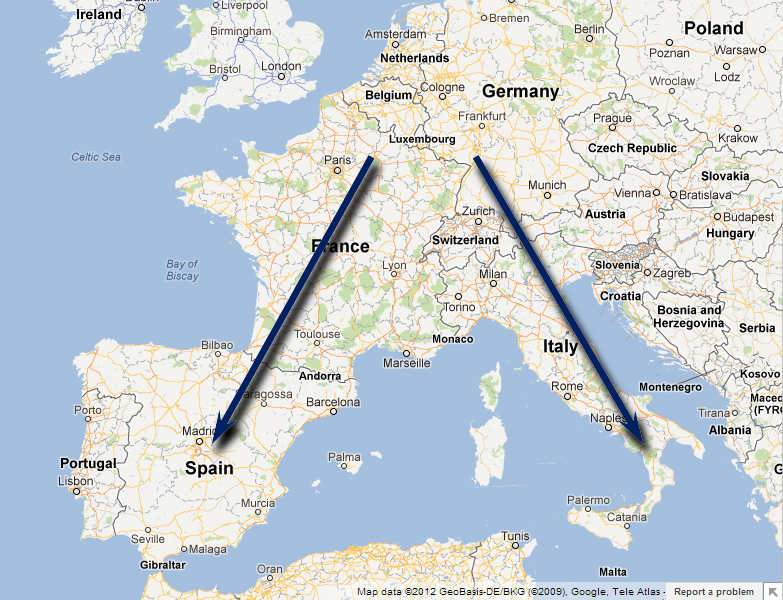
  While not used consistently, one of the best features of Ysearch is its ability to present the most distant known paternal ancestor (MDKPA) and their origin.  So now, I had cousins and their ancestral origins.  The greater the genetic distance, the closer I got to the Caucasus Mountains.  I mapped my closest cousins and their pushpins created a line from the Alps to the North Sea, directly along the Rhine River.  This was a pattern.  I like patterns.  There is usually a scientific reason for a pattern.

Figure 1 – Mapping Ancestral Origins

   I’ve run a few hundred genetic mapping exercises on the majority of Y haplogroups.  The patterns are consistent.  Our ancestors traveled along rivers and coastlines.  They skirted mountain ranges and crossed bodies of water.  There is always a flow to the patterns, but the science and the why were still missing.  I’ve always been interested in early Eurasian history and have tried to associate it to the patterns in the maps that I generated.  Some maps have places and dates that connect well to notable events.  Other maps raise more questions than answers.  Genetic tests and history alone were not making a complete picture.  I needed to add population genetics, migration models, anthropology and evolutionary biology to my knowledge base.
   Take any  two people on the planet, compare their DNA and you can calculate, approximately, how far back in time their common ancestor lived – time to most recent common ancestor (TMRCA).  Our ancestors were nomadic and traveled about 25 to 30 km per generation or roughly 1 km/year on average.  If a common ancestor lived 300 years ago, then that person’s descendants may have migrated 300 km from the geographic origin of that ancestor.  In the figure below, d1 and d2 represent the origins of two known y-DNA genetic records.  The circles show the distance their ancestors may have migrated.  The intersections are the potential locations of their common ancestor.  In this case, there are two intersections, a1 and a2.  More y-DNA records are required to figure out which intersection is correct.

Figure 2 – Distance to Most Recent Common Ancestor (Bilateration)

   The genetic analysis that I have developed is similar to a navigation technique.  Radio navigation uses two or more beacons with known locations and a measurement of the time it takes to receive a signal from each.  The time is converted to a distance.  A current location can then be identified.  In my method, the “beacons” are the ancestral geographic origins. The “signal” is the TMRCA, measured in years, converted to a distance by multiplying the average migration rate – creating a distance to most recent common ancestor (DMRCA).  A location for the common ancestor can then be figured out by looking at the intersections.  Multiple y-DNA records are needed to determine migration direction and geographic origins of a related set of genetic cousins.  The science is starting to take shape.
  I am G-Z726, which is a subgroup of G-Z725.  At Ysearch or on an FTDNA project you may still see an older naming convention - G2a3b.  As an example, let’s look at 18 of my closest genetic cousins – haplogroup G-Z725, (DYS388=13).  TMRCA data is generated using Dean McGee’s Y-Utility.  The output is turned into a phylogenetic tree and the DMRCA is calculated. 

Figure 3 - Phylogenetic Tree - G-Z725 Sample

Each distance is used to draw a circle that represents the migration range of that ancestral line.  My range (MAG) and the range of my next closest cousin on the tree (BAB) create two intersections on the map.  One point is in Africa and the other is in Eastern Europe.  

Figure 4 - Intersection of MAG and BAB

By adding the range of cousin EBE, the correct intersection representing common ancestor 7 (CA7) is identified.  Pairs of records are mapped to continue the analysis.

Figure 5 - Intersection of BIR and RUF

BIR and RUF are another example and they identify common ancestor CA3.  Each record is added until all common ancestors are identified. 

Figure 6 - Common Ancestors Mapped

Connections are drawn based on the phylogenetic tree.
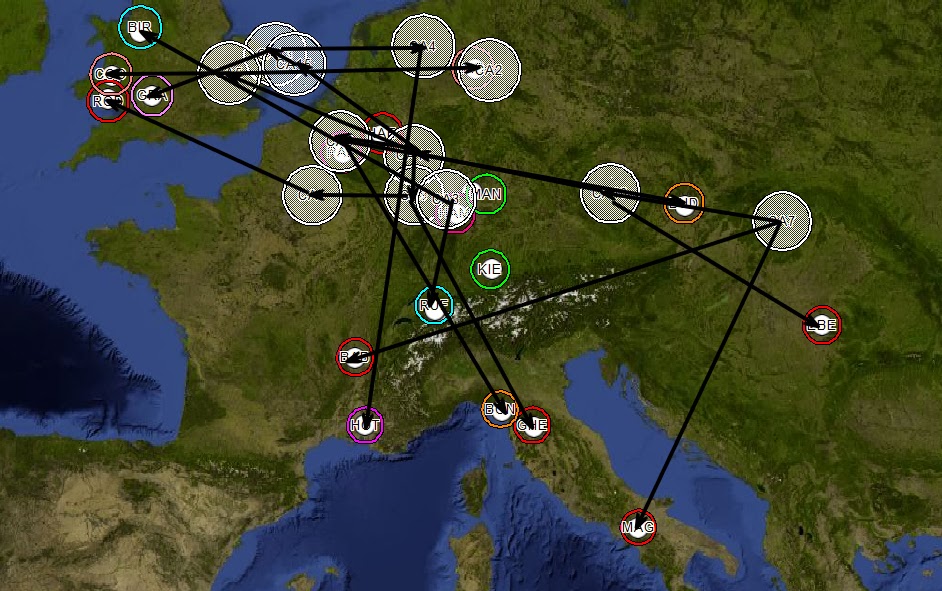
Figure 7 - Phylogenetic Tree Superimposed

Then for simplification, the migration flow is generalized.  Based on the phylogenetic analysis, common ancestor 7 (CA7) is the most distant common ancestor (MDCA) of samples in this example.  The western migration flow has a slight correlation to the Danube River and the North/South migrations have a strong correlation to the Rhine River.  Early attempts at direct mapping of genetic data (Fig. 1) gave similar results based on TMRCA alone.  There was no corroborating evidence of directionality or definitive proof of MDCA.  

Figure 8 - Generalized Migration Flow - G-Z725

   The new methodology that I have developed shows ancestral origins and migration direction.  I call this method biogeographical multilateration (BGM).  It is the geographical distribution of y-DNA data based on multiple distance measurements from reference positions. 
   This method also has the potential to identify the location of a DNA sample when the origin is unknown. For one of my clients, I identified that his paternal ancestor that had immigrated to the United States may have anglicized their name.  The previous name was German and that surname was found predominantly in central Germany.  Applying biogeographical multilateration to my client’s y-DNA results, while leaving the origin as an unknown, indicated a continental European origin within 200km of the city with the highest surname density.
   In the referenced paper, the example haplogroup, I-L22, has an approximate correlation to the Norse/Viking invasions of Britain and identifies a Frisian coast staging area.

Figure 9 - Generalized Migration Flow - I-L22

  We are still in the infancy of what we can learn from y-DNA.  My BGM analysis has room for refinement.  There is enough science out there to help us.  New research is being done at the aggregate population level.  We can apply elements of that research to the individual level.  Biogeographical multilateration has the potential to fill the gap in our knowledge between genealogical records and deep haplogroup roots.  This new tool can give us old world ancestral origins, migration flow and historical timeframes.
   I needed to learn more about my DNA and my origins.  The big testing companies haven’t filled the knowledge gaps that exist.  They are in the business of providing quality test results.  The analysis and tool creation is falling on the shoulders of “citizen scientists”.  Sometimes, you just have to do it yourself.

Reference:

Maglio, MR (2014)  Y-Chromosome Haplotype Origins via Biogeographical Multilateration (Link)

Tuesday, November 20, 2012

Stephen Hopkins: Saxon DNA?


   As we approach Thanksgiving, it’s a great time to write about our Mayflower ancestors.  So far, I have found two on my wife's side, Stephen Hopkins and Stephen Hopkins.  Ok, that’s really just one, but I have two lines that trace back to him.   This isn’t unusual, estimates put the count of Stephen Hopkins’ descendants at about 2 million Americans.  

   What can Stephen Hopkins’ DNA tell us about his origins and his ancestors?  First, I should say that no one has a sample of Stephen’s DNA.  What we know about Stephen comes from tests completed by his male-line descendants with corroborating genealogical paper trails.  The Hopkins families are members of y-DNA haplogroup R1b, the largest genetic population in Europe.  R1b is often associated with the Celtic and Gallic tribes.  Hopkins’ DNA may be able to shed additional light on his birthplace, extend his genealogy further by tapping into an older family line or tell us about his deep ancestral origins.

   One of the first things I like to do is compare the haplotype, (the numeric markers from a y-DNA test) against a public database like ySearch.org.  The goal is to find other parallel lines of Hopkins with ancestry that predates Stephen.  This would allow us to work forward in time, connecting to Stephen and his father John, breaking through the current brick wall.  Unfortunately, no such records exist.

   What we do get from ySearch is list of genetic cousins and their ancestral locations.  Plotting these locations generates a distribution from Kent to Cornwall across southern England.  The highest concentration of cousins is in the historic Anglo-Saxon kingdom of Wessex.  The current research on Stephen Hopkins has him baptized in Hampshire, the heart of Wessex.
 
   What kind of R1b was Hopkins?  Was he a Celt, a Gaul, an Anglo-Saxon or something completely different?  One way to get close to the answer is to look at his genetic cousins again.  Since R1b is such a large group, it is important to focus on both the haplotype and SNP that defines his R1b subgroup.  The SNP that best defines Stephen is S493, which on the 2012 haplogroup tree is R1b1a2a1a1a2.  With the explosion of new SNPs identification and the rapidly expanding and changing subgroup nomenclature, researchers are advocating the use of the SNP rather than subgroup as a naming convention.  Let’s call Stephen Hopkins R-S493.

   When I take all these genetic cousins and run them through TribeMapper®, a pattern forms.  Ancestors start to pile up on either side of the English Channel and an approximate date of migration emerges.  Here’s where we pull out our history books.  If the date were about 2,500 years ago, I would say this was a Celtic migration.  If the date were 2,000 years ago, I might say these were Gaels fleeing the Romans.   The calculations come out to be about 1,500 years ago, putting this migration in line with the Anglo-Saxon invasion of Britain.

   Why stop there?  What flavor of Anglo-Saxon are we talking about?  Angle, Saxon, Jute?  The great thing about tribe mapping is that we can continuously turn back the clock and get a new picture.  If we find a Danish connection, then we might say Jutes or an association to the Angeln region of Germany, we could say Angles.  We have to be careful as those names and locations were just a snapshot in time when ancient historians catalogued Germanic tribes.  Those tribes, like all tribes, were just passing through.

   Stephen Hopkins’ DNA points to a genetic cluster in modern day Lithuania and Latvia.   This data most closely correlates to the Saxons and their origins on the Baltic coast.  Continuing this process gives us the following migration map.


   The R-S493 data takes us through Finland, Sweden and back to the mainland Europe to the Iberian Peninsula.  This puts the origin of R-S493 in Iberia about 4,000 years ago ± 500 years.

   We can’t be certain that Stephen Hopkins has Saxon DNA.  We can’t even say that all Saxons were haplogroup R1b.  It’s unlikely that they were a single homogenous ethnic group, but the core of the tribe would have had strong familial and genetic ties.  Were Hopkins’ ancestors at the core of this tribe or part of the fringe, picked up along the way?  A broader study of DNA associated with the same places and times would be required to answer that question.

   If we look at the surname Hopkins, its origins are from Hobbes-kin and even further back to the Germanic name Hrodberht.  Stephen Hopkins and his closest genetic cousins are found in the historic Kingdom of Wessex (West Saxons).  Time-wise, there is a correlation to the Anglo-Saxon invasion of Britain.  We can even make a connection to the proto-Saxons along the Baltic coast.  I’m going out on a limb and calling Hopkins a Saxon.

   That Saxon bloodline remained adventurous and served Stephen well as he voyaged to Bermuda, Jamestown and Plymouth colony.

   It’s never obvious where DNA will lead.  Each tribe mapping is an adventure in itself.


© Michael R. Maglio and OriginsDNA

Thursday, September 27, 2012

Find Your Inner Barbarian...

Was your family part of the Anglo-Saxon invasion or did they ride with Attila the Hun?


Join us tonight at 7pm at the Southborough Public Library as the Southborough Genealogy Club hosts and I present Mapping Your Tribe.

Friday, September 21, 2012

Vandals DNA: Leaving Genetic Graffiti Across Europe


   I have been fascinated by barbarian history since my sixth grade Social Studies teacher, Mr. Rose, handed me the textbook on the subject.  I still read everything I can on the topic.  The biggest draw is the mystery of where each tribe came from, appearing out of the shadow of mythology and for many, disappearing into obscurity.  I’m finding that DNA can help answer the questions of ‘Where are they now?’ and ‘Where did they come from?’

   The word barbarian is first seen in the Greek language as barbaros.  One possible origin of the word is that it was coined from the sound of the language used by these nomadic tribes – ‘bar bar bar’.  The Vandals (Vandali) appear in the history books as early as 166 AD and are described as an East Germanic tribe.  The theories on their origins include having Scandinavian roots in the parish of Vendel, Sweden or Germanic roots with a connection to the word meaning to wander (wandeln).

   Even if the Vandals’ name wasn’t derived from the word wandeln, wandering was what they did the most.  Perhaps chased is a better description.  Around 300 AD, the Goths fought with the Vandals and pushed them west along the Danube River.  By 400 AD, the Huns pushed the Vandals further west to the Rhine River.  At the Rhine, the Vandals fought with the Franks, won and moved into Aquitaine (western France), pillaging and plundering the whole way.

Historical Vandali migration

   I’m reminded of an old cartoon where the barbarian leader is addressing his troops – ‘This time, remember: pillage, then burn.’  The term vandalism is directly attributed to the Vandals’ ruthless pillaging and destruction of culturally significant objects.

   In 409 AD, the Vandals crossed into the Iberian Peninsula, only to be chased by the Visigoths and the Roman army into North Africa in 429 AD.  Over the next decades, the Vandals conquered North Africa and made Carthage their capital.  From there they invaded Sicily, Sardinia, Corsica and in 455 AD they sacked Rome. Fortunes fade, the Vandals were defeated by the Byzantine Empire in 534 AD and disappeared into history.  The name Vandals may have disappeared but the people didn’t.  They were either assimilated into the local cultures or dispersed as slaves, the spoils of war.

   To figure out ‘Who were the Vandals?’, first I had to figure out ‘Where are they now?’  Based on their historic origins, the Vandals would probably fall into a small group of y-DNA haplogroups.  The ethnic descriptions that I’m using are overly simplistic, just enough to give you a feel for the possible cultures present.


Haplogroup
Culture
G2a
Caucasian
I1
Scandinavian
I2a
Danubian
N
Finn
R1a
Balkan
R1b
Celtiberian


   We can’t assume that the Vandals were genetically homogenous.  At various times they were associated and allied with the Alani and Suevi tribes.  Any DNA trail found, could just as easily belong to a group along for the ride.  I started researching all these haplogroups along the Vandals’ 400-year migration route to find a DNA footprint. The key datasets included records from Sicily, Sardinia, Tunisia, Spain, France and Germany.  These locations create a triangle of migratory patterns, clockwise, counterclockwise and dispersion.  If these sets have evidence of Vandals DNA, there should be a counterclockwise flow around Europe and a west to east flow across the Mediterranean.  Immediately I was able to remove haplogroup N from the running, there were no records.


   I have to admit that going into this project I thought that the Scandinavian I1 haplogroup would be my most likely suspect.  I had built a picture in my mind that all the Germanic tribes had come out of Scandinavia.  I researched this group first, looking for genetic flow across time. Usually I work with an individual record and trace backward through time.  For this project, I’m analyzing large groups in multiple datasets.  At a high level I’m searching for DNA that has migrated from Germany, through France and Spain to Tunisia and then to Sicily and Sardinia.

   Using TMRCA (time to most recent common ancestor) and my own TribeMapper techniques, I was able to identify that the Scandinavian I1 haplogroup formed a parallel dispersion pattern.  The y-DNA genes flowed from Germany down into the Italian peninsula and into the Iberian Peninsula at roughly the same time.  Haplogroups G2a and R1a also fall into this category of dispersion.  These DNA records don’t fit the pattern of the Vandals’ migration.

I1, G2a & R1a migration pattern

   The R1b Celtic-Iberian haplogroup proved more difficult to decipher.  This is a major group in Europe, representing over 60% of the Western European population.  For over 10,000 years, there has been a strong flow out of the Iberian Peninsula toward the British Isles, Germany and Scandinavia.  Detecting a counterflow against that tide is problematic.  The apparent direction of migration across the datasets I researched shows a clockwise pattern out of Spain, into France and Germany and then down the Italian peninsula.  R1b doesn’t look like our Vandals, but I’m going to reserve judgment until better analysis tools are developed.

R1b migration pattern

   I’ve left haplogroup I2a, the Danubians, for last because they have the best correlation to the Vandals.  Their genetic migration does show a counterclockwise flow from Germany, through France and Spain and into Sicily and Sardinia.  This DNA can be found in the historic Vandali regions of Aquitaine, Galicia, Lusitania and Andalusia.  Haplogroup I2a is a dominant Germanic group associated with the Danube River, giving them the nickname Danubian.  This matches the Vandals earliest historical references.

I2a migration pattern

   Myles Standish of Mayflower fame was also haplogroup I2a.  Standish is not closely related to the DNA that I am chasing.  His tribe and the Vandals parted ways over 5,000 years ago.

   Have I found the Vandals, Alans or Suevi?  So far, I have been looking at the past 2,000 years.  If I expand the datasets and research back further in time, additional patterns appear.   The DNA takes me to Georgia, Armenia and Iran.  The timing and the location of these records put us in the historic Alani homeland on the Asian steppe.  The Huns were also responsible for driving the Alans west into Europe around 300 AD.  I’ve been looking for Vandals and I’ve found the Alans instead.


   The I2a1 tribal haplotype that I have identified has remained relatively unchanged for thousands of years and has allowed me to follow a migration in and out of Asia and across Europe.  I cannot say that I have found the DNA of all the Alans or that the Alans were only haplogroup I2a.  The correlations that I have made are based on records currently available and it is impossible to say what additional future DNA records may reveal.

   The mystery of the Vandals remains a mystery.  I now have an unexpected peek at a piece of the Alani origins and migrations.  When clients want to know more about their DNA, I can check them against this data.  I’d love to be able to get to a point where I can tell folks - ‘Hey, you’re a Visigoth!’  One of the biggest parts of DNA testing beyond finding family, is connecting ourselves to history, knowing that your ancestors played a role.

© Origin Hunters & OriginsDNA

Monday, August 20, 2012

The DNA of John Cutter West: Connected and Disconnected


   Bill West, author of the blog series ‘West in New England’, has been writing about his ggg-grandfather, John Cutter West, for over five years.  Bill calls him ‘The Elusive John C.’
                                               

   Some genealogies connect John Cutter West as the son of Paul West and Hannah Crowell of Liverpool, Nova Scotia.  It has also been suggested that he could be the grandson of Josiah West and Elizabeth Griffith of Plymouth, MA.  Both Paul and Josiah are descended from Francis West of Salisbury, England who immigrated to Duxbury, MA.

   Bill West completed a 37-marker y-DNA test and his results came back as haplogroup J2.  Multiple descendants of Francis West have also been tested.  Their results indicate that Francis West was a member of haplogroup R1b.  Bill is related to Francis West in the same way that J2 is related to R1b, but you have to go back 40,000 years ago to find that family connection rather than 400 years.  DNA results can be a double-edged sword.  They can prove your connection or just as easily disprove your assumptions.

   One of the most exciting events in DNA testing is when you receive your results showing multiple matches with your surname.  If you have already researched a dozen generations, the test is confirmation.  If you are just getting started, the test connects you with cousins.  Or, if you were adopted, getting matches to multiple records with a surname you weren’t expecting will lead you on a path of discovery.  In a survey of major DNA databases, Bill’s genetic record didn’t have any close matches.  The wonderful part of y-DNA testing is the ability to dig deeper.

   Here is what we do know about Bill’s DNA.  Haplogroup J2 has origins in Mesopotamia about 18,500 years ago and it is associated with speakers of the Semitic languages.  The J2 haplogroup is widespread around the Mediterranean with connections to both Arabs and Jews.  Bill’s haplotype, the 37-markers from his test, are a genetic fingerprint that can help us find his tribe.

   I've developed a tool, TribeMapper®, which allows me to take a haplotype record and map ancestors across time and place.  One of the first clues we find is that Bill’s haplogroup is more uniquely related to subgroup J2b2.  Only a test looking for SNP M241 can prove J2b2 for certain.  My next step is to map the DNA to determine which J2b2 ethnicity Bill belongs.

   As I look at slices of time, 4,500 years ago Bill’s ancestors were in places like Turkey, Armenia, Syria and Saudi Arabia.  If I look at a branch of Bill’s tribe at about 3,000 years ago, I see a distinct correlation with locations like Cyprus, the coasts of Italy and Spain and the islands of the Azores.  These places match up with the colonies of the Phoenicians.  Phoenicia had origins in what is modern day Lebanon.  They were known for their extensive maritime trading culture. Phoenicians were not only sea travelling merchants with colonies around the Mediterranean, they had trade routes across Europe as well.  Bill’s closest DNA matches were part of a Phoenician branch that headed into central Europe.


   Looking at a period from 1,300 (Bill’s closest match) to 2,000 years ago, we see a pattern of migration into what is modern day Germany and more specifically those genetic connections appear in cities in the Hessen region.  Research into John Cutter West gives the appearance that he has English origins.  The DNA trail ends in southwest Germany.  We are still left with the fact that there are not enough DNA records to fill the gap between now and 1,300 years ago.  It is possible that Bill’s ancestors migrated further, from Germany to England.

   Now it’s time to move from facts to theory.  The closest DNA matches indicate a connection to the Hessen region of Germany.  An avenue worth investigating is whether one of those ancestors was a Hessian soldier that stayed in America after the Revolution.  Perhaps the reason there are no records of John Cutter West before his 1827 marriage record is that he was born under a different name, a more German sounding name.

   Sometimes DNA can help us make all the connections.  In the case of Bill West, he is still disconnected over the last 1,000 years.  That’s a big space of time with plenty of questions.  More folks are being tested every day and the DNA databases are growing.  Today the data shows that Bill has deep Phoenician roots and that those ancestors settled in the German region of Hessen.  Time and more data will help revise and refine this picture of Bill’s tribe.

© Origin Hunters & OriginsDNA

Friday, August 10, 2012

Genealogy Gold: McCarthy DNA


   Sometimes in genealogy, we go for the gold.  We try to figure out how we are descended from Presidents, royalty or other famous people.  In the US, if your last name were Adams, you might ask if you are related to the second President.  With a surname like Stewart/Stuart you could try to research back to UK royalty.  If you are Irish, some of those royal names are O’Neill, O’Brien or McCarthy.

   The last King in Ireland died in the 1600s.  For many of us it is incredibly difficult to go back beyond the 1800s in our Irish genealogy research.  The lack of paper records makes finding that connection to Irish royalty challenging.

   DNA is the next best answer to the lack of records.  Both regional and surname projects can collect enough genetic samples to build family trees.  Not in the same sense as child - father - grandfather etc., more in a phylogenetic sense.  A phylogenetic tree will show how individuals connect back to common ancestors and in turn, those common ancestors trace further back to another common connection.

   I have McCarthy ancestry and like everyone else I have researched as much as possible about one of my surnames.  Historically the surname comes from Carthaigh or Carthach, an 11th century King of Ireland and ancestor of the McCarthy Kings of Desmond (current day Cork and Kerry).  His son, Muireadhach, was the first to take on the Mac Carthaigh name.  Literally the ‘son of Carthaigh’.  In names like O’Neill or O’Brien, the O’ means grandson or descendant.

   Time to go for the gold.  How am I related to the Kings of Ireland?  Which DNA haplogroup do the McCarthys belong?  First, I found that a surname project existed on Family Tree DNA.  Then I started analyzing the data on the McCarthy Surname Study DNA site.  Nothing is ever simple.  There are six different haplogroup represented in the group, E1b, I1, I2a, I2b, R1a and R1b.  There are also four different R1b subgroups.  The site has R1b divided into Group A (SNP R-L21), Group B (SNP R-P314.2), Group C (SNP R-M222) and Group D (misc. others).  I would expect there to be multiple R1b subgroups as it is the most numerous haplogroup in Western Europe.

   Like the Olympics, there can only be one gold medal winner in this event.  Only one (or none) of these groups can be related to the original Carthaigh.  There are many reasons why there are multiple McCarthy haplogroups.  The Administrator of the McCarthy site, Nigel McCarthy, is well aware that there could be non-paternal events and has posted some possible situations where a McCarthy name could have arisen:

“•Soldiers, serfs, or slaves or hostages taken in battle and who remained with their captives, all under the tutelage of a McCarthy king, chief of chieftain, adopting this surname.
•Rape of McCarthy womenfolk by invading forces.
•Other illegitimacy.
•Adoption (e.g. by a chieftain of a sister’s orphaned children).
•Raiders such as Vikings being absorbed, a century or two after they settled in Ireland,  into the group which became the McCarthy family as they became “gaelicised”.
•Stepsons taking the McCarthy name of their new stepfather (early deaths of husbands or wives, and thus remarriages, were common).
•The sons of Cárthachs other than he who died in 1045 forming their surnames in a similar manner (although there is no explicit evidence of this).”
-source McCarthy Surname Study - Background

   Which genes are the royal McCarthy genes?  Other projects have been able to analyze DNA records and come back with an announcement that they have identified the haplotypes of Genghis Khan or Niall, ancestor of the O’Neill kings.  The same methods should work for the McCarthys.  If we consider the McCarthy DNA records as a random sample representing the larger population, then the groups with the larger number of records are more likely to be part of the royal group.  A wealthier family would have had more resources to provide for larger families, allowing for more descendants.

   Looking at the McCarthy site, haplogroup R1b Groups A and B have the most records.  At first glance, the other haplogroups seem to be ruled out for lack of representation.  An analysis of the haplotypes within these haplogroups gives us additional evidence.  The E1b group shows a clear pattern of migration from Greece through Italy, Germany, England and Scotland before arriving in Ireland.  This is consistent with the Alexandrian origin of E1b and the timing fits with Rome’s incursion into the region.


   Haplogroup I2b shows a migration from the Danube River region through Germany, England, Scotland and into Northern Ireland.  They appear to have arrived before the Romans.  Haplogroup R1a originated from Eastern Europe and took a different path via Normandy, Devon/Cornwall, into Ireland through Cork.  Their timing fits the Norman invasion of Ireland about 900 years ago.

   If we calculate the time to most recent common ancestor (TMRCA) for Groups A and B, we see that within each group they are closely related.  For each group, their common ancestor lived about 1,000 years ago, which coincides with Carthaigh’s timeframe.  Comparing the two groups against each other shows a common ancestor over 2,800 years ago.  Both groups have the right ancestral timing.  Group A has DNA that is associated with Southern Ireland and an analysis across a larger R1b tribal haplotype indicates that this group entered Ireland over 2,600 years ago.  The same analysis of Group B indicates that they entered Ireland about 500 years later.  Group A has been in Ireland longer and occupy the ancestral region of Desmond.


   So far, we have circumstantial evidence.  We need something more concrete.  We can get a clue from the historic royal genealogies.  The McCarthys were more than just a royal family.  They were a dynasty.  Along with the surname McCarthy, there were also the Sullivans, Callaghans, Keeffes, Donoghues and Donovans that made up the larger related genetic dynasty.  Looking at each group in the context of the larger genetic pool of records and surnames shows that Group A has a close DNA connection to the dynastic surnames and Group B does not.  This method was a key factor in the O’Neill project.

   The evidence points to Group A as the descendants of the royal McCarthys.  The haplotype for Carthaigh is slightly different from the modal for the McCarthy Project Group A.  Considering the dynastic records, makes the values of DYS576=19 and DYS442=13.


   The pedigree of Carthaigh’s ancestors borders on mythology.  Many Irish pedigrees trace back to Milesius of Spain as the father of the Irish people.  Historians found it easy to dispute these claims as these records often are full of conflicting historical information, a lack of dates and obvious attempts to connect back to the Biblical genealogies.  As with most mythology, the Irish origins contain grains of truth.  Haplogroup R1b, which is predominant in Ireland, has its origins in Iberia (modern day Spain and Portugal).  The McCarthy Group A DNA data can be traced backward in time via STR mutations to their Spanish and Portuguese cousins.  Imagine two brothers at a farewell party on the slopes of the Pyrenees 3,000 years ago.  One brother has decided to go north to seek better fortunes and the other decided to stay behind.  The ancestors of each exist today for us to compare.


   The Irish do have ‘Spanish’ origins.  Some elements of that oral history remained intact over 3,000 years as the Iberian tribe migrated and settled in Ireland.  As with any oral tradition, embellishment can occur, especially when developing a royal pedigree to show divine right.

   McCarthy Group A was not the first Iberian tribe to land in Ireland and certainly not the last.  Group B arrived about 500-1,000 after Group A.  Irish mythology suggests that there were at least four previous waves of immigration to Ireland from the mainland.  The E1b McCarthy ancestors begin to show up around 2,000 years ago with the Roman invasion and the R1a McCarthys are associated with the Norman invasion of Ireland about 900 years ago.

   My next steps are to find my male McCarthy cousins and get them tested.  I’ll look for at least two, one from each of my g-granduncle’s surviving lines.  My McCarthys trace back to Kilmichael Parish in County Cork and my gg-grandfather, Florence McCarthy, has one of those names that repeats throughout McCarthy history.   I look forward to finding out which McCarthy DNA group I belong.

   If you are a McCarthy, please consider DNA testing and joining the McCarthy DNA Project.  Your data will help build a better understanding and a better genetic family tree of the McCarthy groups.  Along the way, we can learn more about our ethnicity and our Irish culture.  You may even want to change your surname back to its original Irish spelling, Súilleabháin (Sullivan), Ceallacháin (Callaghan), Donnchadha (Donoghue), Donnabhain (Donovan) or Mac Carthaigh.

© Origin Hunters & OriginsDNA

Monday, July 30, 2012

Armenia, DNA and Ethnicity


   Self-identity, what culture or ethnicity do you identify with?  Your current culture?  Your immigrant ancestor’s culture?  Perhaps you identify with a culture buried deep in your DNA.

   See this article as a great primer on the differences between - Ethnicity, Nationality, Race, Heritage, and Culture.

   Culturally, my wife is an American.  I could even say that she is a New Englander.  She grew up in an Armenian family, but she doesn’t know the language.  What she does identify with is the food and family.  Her immigrant grandfather, Reuben, was born in Turkey.  Turkish was his nationality, but culturally he associated deeply with the Armenian heritage that was strong in Adana.

   Nations redraw their lines, form and dissolve over the course of decades.  If you had lived in central Europe over the past few hundred years, one day you might be French and the next day German, only to be French again in a week.

   How long does it take us to lose our ethnicity?  If I took my family to Armenia and we stayed there for three or four generations, would they think of themselves as Armenian American Armenians.   I doubt it.  Each generation would absorb the culture around them to a greater degree.  Given enough time, some descendants might think that it was just family mythology that they ever lived in the US.  We’ve always been here.

   We are all immigrants or descendants of immigrants.  That goes for the entire planet.

   If I look at another side of my wife’s family, they’ve been in America for over 350 years.  Their immigrant ancestor, Edward Clark, was ethnically English.  In turn, Edward’s immigrant ancestor was Norman and the immigrant ancestor before that was Danish.  I can keep going back, Iberia, Asia and Africa.  Which culture should they identify with?  Nationality is fleeting and uncertain.  Ethnicity is in your genes, embrace all the cultures of your ancestors.

   About 50,000 years ago, there were no humans in Armenia, or for that matter, Asia Minor.  Over the intervening years, folks trickled in from every direction.  Let’s look at the current distribution of Armenian y-DNA.


Haplogroup
Percentage
Culture
J1c & J2a
32%
Arabic / Semitic
R1b
25%
Iberian/Gaul
G2a
14%
Caucasus
E1b
8%
Alexandrian
I2a & R1a
8%
Balkan
T1
6%
Mid-eastern
L2a
4%
Dravidian
Q1
1%
Hun


   This is a snapshot of modern Armenia.  Without analyzing individual haplotypes from this dataset, it is difficult to determine which group arrived first.  More than likely each group had multiple waves of immigration across history.  I’ve created the map below for you to get a feel for the origin and flow of the major haplogroups.


   It’s not unusual for groups J1c, J2a and G2a to have high percentages.  Those groups also have their origins in that region.  The large portion of R1b can be attributed to the crusaders passing through for hundreds of years.  Many of the taverns in this region have signs that say, ‘Alexander the Great slept here’.   His empire would have contributed the E1b DNA as they conquered eastward and the Dravidian DNA flowed back toward Greece with the spoils.  The Roman and Byzantine influence brought the Balkan DNA.  The Huns also stopped by on their way to conquer Eastern Europe.

   My wife can count Armenian as part of her heritage, with roots on the Mediterranean coast of Turkey.  Someday I will find her living Armenian cousins in order to get DNA tests.  Those results will allow me to identify her deeper ancestral ethnicity.

   On another line, she is descended from four generations of Sea Captains from Maine with Scottish origins.  Should my wife self-identify with all the cultures of her ancestors?  Probably not.  Should she learn about and understand all those cultures?  Definitely.  We can pick and choose the best parts of our ancestral heritage and create our own unique ethnic identity.  She has a love for the ocean that didn’t come from any early family experience.  It’s in her DNA.

Wednesday, July 4, 2012

Attila, Native Americans and DNA: A Hunny Story


   Recently at a conference, I was talking to some folks about DNA and the migration of tribes based on haplotypes.   A question came up, "What about the Huns?"  I had to answer that I had never looked into the Huns. That night I started looking for evidence that the Huns left a genetic footprint.

   I usually take the DNA of an individual and work backwards to find their origins.  In this case, I started with the origins and tracked forward in time.  The Huns were a nomadic tribe of people that arrived from eastern Asia around 150 AD.  They built a European empire that lasted until 469 AD.  The height of the empire was under the reign of Attila.

   The Huns were not a homogeneous group.  They integrated those that they conquered.  The Alani and the Ostrogoths were a few of the assimilated groups.  Their DNA would have been eastern European, perhaps R1a, G2a, I1 or I2 and a minority proportion, but the core and the majority of the Huns, based on historical reference, would have been East Asian.

   By the end of the Hunnic Empire, the Huns had spent over 300 years, 12 generations, in Europe.  Unlike the later Mongol invaders, the Huns had no Asian home to return to.  They, in turn, were assimilated into the cultures they once ruled and left descendants across Europe.

   Most likely the Huns were from eastern Asian origins.  That limited them to haplogroups C – ‘Mongol’, D – ‘Tibetan’, N – ‘Han/Finn’, O – ‘Manchurian’ and Q – ‘Altaic’.  The ethnic descriptions that I’m using are overly simplistic, just enough to give you a feel for the possible cultures present.   I surveyed DNA record sources for Russia and Europe, looking specifically for these haplogroups.  Groups D and O were isolated individuals, easily attributed to Silk Road travelers who settled in Europe.  Group C was predominantly C3 and related to the later Mongol invasion.  N was either heavily Finnic or a few isolated Siberian individuals.  Q was a different story completely.


   Haplogroup Q has origins in Siberia, most likely north of the Altai Mountains.  Q is also the origin of the Native Americans.  The majority of the Native America haplogroup is Q1a3a.  What I found was a significant Q1b and Q1a2 population in Eastern Europe.  When I map the Q1b genetic footprint using TribeMapper they fall exactly north of the Danube River and east of the Rhine.  This corresponds to the territory of the Hunnic Empire.  The Q1a2 group maps to Hungary, the royal seat of the empire.

   These Q1b and Q1a2 are close-knit tribes each with common ancestry within the last 2100 years.  The timing of their common ancestry and their geographic footprint make a strong argument that these two Q groups were the genetic core of the Hun invaders.

   A few caveats.  Not every European in haplogroup Q is a Hun.  There is a population of Q1a3a, a closer relation to Native Americans, living in Sweden that doesn't correlate.  Not every Hun is a Q, there are bound to be some other groups mixed in like the isolated N individuals as well as the folks the Huns picked up along the way.

   When we think of the Huns, probably the first person who comes to mind is Attila.  Attila was the second to last ruler of the Huns at the height of the empire.  He died in 453 and the empire crumbled in 469 AD.  There is no evidence to say that Attila fits into either the Q1b or Q1a2 group.  If I had to pose a theory, I would say that Attila is Q1a2, part of the royal class of Huns living in Hungary.

    The Huns (Q1a2 & Q1b) and the Native Americans (Q1a3a) share a common Asian ancestor around 18,000 years ago, most likely from the Altai Mountain region.  Not all of the ancestral Q1a3a traveled to the new world.  Some remained in the old world and are found across Siberia and into Scandinavia.  If you live in the Americas and you have been tested as a Q, don’t automatically assume that you are Native American.  Get a deep clade SNP test for confirmation.

   The combined evidence of DNA, geography and history leads to the conclusion that at the end of the Hunnic Empire, the core East Asian Huns assimilated into the eastern European cultures.  They left behind a strong genetic footprint in the same territory that they historically inhabited.  The next time I’m asked, “What about the Huns?”  I can point to Europe and say, “They’re still there.”

Friday, June 15, 2012

Myles Standish: Mayflower DNA


   My genealogy has one Mayflower passenger, Stephen Hopkins.  Seven other passengers are cousins in one manner or another, Doty, Howland, More, Mullins, Standish, Warren and Winslow.  Twenty-four of the Mayflower families have living descendants.  I have collected the y-DNA records for fifteen of them. (For more on this process watch this short video) It was no surprise to find eight R1b Celts and four I1 Scandinavians among them.  But, the three I2a Balkans intrigued me.

   The one name that stood out as I2a was Myles Standish.  Every first grader knows that name.  My first thought was that Myles was descended from a member of the Roman Legions.  Perhaps he was a Scythian or Sarmatian.  I needed to identify the Standish family tribe and when they arrived in England.   If I was lucky, I’d be able to bracket the immigration of his ancestor to the 1st or 2nd century, the height of the Roman conquest.

   As the DNA records started to compile using TribeMapper® analysis, an initial pattern developed showing historic habitation on either side of Hadrian’s Wall.  This was the beginning of a great migration story and potentially the end to the dispute of Myles Standish’s origins.  Researchers have placed Standish’s birthplace as either Lancashire or the Isle of Man.  Based on the data, Lancashire emerges as the most likely location.  There was no genetic indication that the Isle of Man was a possibility.

   If Standish’s ancestors had been conscripted into the Roman Legion, then I would expect their migration pattern to appear scattered like a diaspora.  Fathers and brothers and their descendants would be spread across the Roman empire.  There would be no focus for the data points representing the period 2,000 years ago.

   The actual data points told a different story.  They remained focused.  At the end of the last ice age, about 10,000 years ago, Myles Standish’s ancestors were living in the Balkans.  As the ice receded, they journeyed up the Danube River, a major migration highway, until they reached the upper Rhine.  The upper Rhine was a Neolithic way station for many tribes coming up the Danube or out of Iberia.  The area served as a stopover before continuing over the Alps or down the Rhine.  The Standish tribe chose to follow the Rhine down to the North Sea.


   Between 2,000 and 3,000 years ago, Standish’s ancestors crossed into England and made their way up the Thames to its source.  My theory is that they were pushed ever westward by successive waves of immigrants.  They found Wales to be well populated already and ventured north to where we find the most recent genetic evidence, in Lancashire.

   My initial theory that Standish’s ancestor was brought to England as part of the Roman Legion, to reinforce the troops at Hadrian’s Wall, was wrong.  It is always good to have a theory to work toward, but don’t let preconceived ideas get in the way of new evidence.  Now that we know that Standish’s origins are pre-Roman we can consider that his family is one of the native tribes of Britain.  The most likely Lancashire tribe would be the Setantii, which is a sub-tribe of the Brigantes.

   Each one of our ancestors has a unique migration story to tell.  Their travels overlap with events that we have read about in history books.

   Where did you come from?

© Michael R. Maglio and OriginsDNA

Monday, June 11, 2012

Who's Who in the DNA Zoo


   When I talk to folks about y-DNA, I like to give the haplogroups an ethnic identity.  Rather than just saying that they are R1b, I also talk about their Western European or Celto-Iberian deep ancestry.  This helps them associate their DNA in a historical and geographical context.  It is important to understand that your nationality is just the outside of the onion, with many more ethnic layers beneath.


   I’ll pick on England for second, because they’re an island.  Roughly 10,000 years ago, nobody lived in England.  It was still recovering from the Ice Age.  Over the past 10,000 years, England has seen wave after wave of immigrants and invasions.  It’s only been the last 2,000 years that we can label these new comers as Romans, Vikings, Anglo-Saxons or Normans.  If you consider yourself English, think again.  What is that next ethnic layer?

   If you want to know the answer, I suggest taking a DNA test to get your ancestral origins.  The approximate cultural identities that I use for y-DNA are:

  • C3 - Mongol
  • E1b – Greek / Egyptian
  • G2a – Caucasus / Etruscan
  • I1 – Scandinavian
  • I2 – Balkan / Danubian  
  • J – Phoenician / Semitic
  • N1c – Finn
  • Q1a – Siberian / Native American
  • R1a – Balkan / Slavic
  • R1b – Celtic (most common in Europe)

   I see these haplogroups consistently in Europe.  There are many more, worldwide.  Even these ethnicities are too generalized.  Throughout history, the R1b and I1 folks have shared geography from Iberia to Scandinavia.  It may be easy to describe someone as Celto-Scandinavian, but it is difficult to say Scandinavian-Iberian.  Location based naming conventions are tough to use for nomadic tribes.

   Perhaps you are English and have taken an autosomal DNA test.  As part of the at-DNA test, you get an ethnic population distribution.  It might say that you are 100% Scandinavian.  Now you have peeled back one more layer of your ethnic onion.  What flavor of Scandinavian are you?  This is where y-DNA can help place you in either the R1b, I2, N1c or even Q1a group.

   You could find out that you are R1b Scandinavian (with Celto-Iberian roots) and that more than likely your ancestors entered England as part of the Anglo-Saxon invasion.  One more layer peeled back.  I know that R1b men were among the Anglo-Saxons.  That doesn’t mean that they were a homogenous group.  Perhaps you are more Angle than Saxon or even Jute.

   Many of these nomadic haplogroups traveled the same river highways and lived in the same regions.  Today the genetic groups are thoroughly mixed in every country.  It is difficult to pick a time in history when we weren’t mixed.  History books are full of the great battles between nations.  Where is it written that two tribes co-existed, worked together and built a new common heritage?

   I can count Italian as part of my heritage, with roots in the mountains outside of Benevento.  That definition of me only has a 150-year history.  Prior to 1860, Italy was not a unified country.  3,000 years ago, my ancestors were living on the north side of the Alps in what is now Switzerland.  That doesn’t make me Swiss or does it?  7,000 years ago, my ancestors lived along the Danube River.  Now I’m Danubian.  Before that, we were in the Caucasus Mountains.  I sense a mountain theme going on here.  Perhaps I should call myself Caucasian?  My y-DNA haplogroup is G with origins in the Caucasus and my autosomal test indicates a close relation with the Adyghe or Circassian tribes of current day Russian Georgia.  A rough translation of the word Adyghe means ‘mountaineer who lives near the sea or between two seas’.  The Italian peninsula must have made a great home away from home.

   I could continue to peel back the layers of my ethnicity.  Genetically we could all say that we are African.  Who we really are and what culture we associate with has gotten a bit more complex.  My y-DNA is just a fraction of my identity.  I enjoy the music of Scottish bagpipes while drinking Irish beer or eating a nice slice of lasagna with a glass of German wine.  I have a craving to hike in the mountains, go figure.