Saturday, February 2, 2013

Are You Special?

Deep Into DNA*

We are all special in our own quirky ways. How much does your DNA play a part in who you are? Perhaps you’re not who you think you are. If you’ve received DNA results from one of the major tests, y-DNA, mitochondrial DNA or autosomal DNA, you might already have a glimpse into what makes you special.


Beyond the big tests that give you distant paternal or maternal ancestry or a pie chart of your ethnic mix, there are many specific tests. What percent Neanderthal are you? There’s a test for that. The jury is still out on whether your Neanderthal genes are from a direct descendant or just shared from a common ancestor. When we start talking about what percent chimpanzee you are (yes, there’s a test for that) we are definitely talking about a common ancestor going back seven million years. Just to be clear, we are not descended from chimpanzees or any other living ape, but as cousins, we do share DNA.

...continued at The In-Depth Genealogist with a free membership.


*The Deep Into DNA article series is published each month in The In-Depth Genealogist Newsletter and will demystify genetic genealogy and make sense out of DNA testing terminology. Each month we will talk about the types of tests available from major labs and show relevant examples on how to use DNA in your genealogy research.

#gDNA

Saturday, December 22, 2012

Testing All Your Genes

Deep Into DNA*

   We all have 46 chromosomes, 23 from mom and 23 from dad. Two of those chromosomes are the sexy kind, X and Y. We’ll ignore those for now. The other 44 chromosomes are your autosomes. Autosomal testing has become available only within the last few years and has become a very popular choice. It offers the broadest range of results, including cousin matches, ethnic proportions and health indicators.


...continued at The In-Depth Genealogist with a free membership.


*The Deep Into DNA article series is published each month in The In-Depth Genealogist Newsletter and will demystify genetic genealogy and make sense out of DNA testing terminology. Each month we will talk about the types of tests available from major labs and show relevant examples on how to use DNA in your genealogy research.

#gDNA

Monday, November 26, 2012

Genetic Genealogy: Adding DNA to Your Toolkit


We’re all cousins! Genetic genealogy can tell us just how closely we are related.

Each of us already has a key to a library of knowledge about our ancestors, it’s in our DNA. Until recently, genealogists have relied on oral tradition and historical records. With DNA for genealogy, we now have a valuable new type of evidence.


Join us on November 28th at 6pm at the Boston Public Library as the Local & Family History Lecture Series hosts and I present Genetic Genealogy: Adding DNA to Your Toolkit.  We will look at the variety of testing options and the potential mysteries that they will unlock.  Learn about your deep ancestry, confirm your existing family history or break through brick walls in your genealogy research.

See how easy it is to add DNA to your genealogy toolkit.

Tuesday, November 20, 2012

Stephen Hopkins: Saxon DNA?


   As we approach Thanksgiving, it’s a great time to write about our Mayflower ancestors.  So far, I have found two on my wife's side, Stephen Hopkins and Stephen Hopkins.  Ok, that’s really just one, but I have two lines that trace back to him.   This isn’t unusual, estimates put the count of Stephen Hopkins’ descendants at about 2 million Americans.  

   What can Stephen Hopkins’ DNA tell us about his origins and his ancestors?  First, I should say that no one has a sample of Stephen’s DNA.  What we know about Stephen comes from tests completed by his male-line descendants with corroborating genealogical paper trails.  The Hopkins families are members of y-DNA haplogroup R1b, the largest genetic population in Europe.  R1b is often associated with the Celtic and Gallic tribes.  Hopkins’ DNA may be able to shed additional light on his birthplace, extend his genealogy further by tapping into an older family line or tell us about his deep ancestral origins.

   One of the first things I like to do is compare the haplotype, (the numeric markers from a y-DNA test) against a public database like ySearch.org.  The goal is to find other parallel lines of Hopkins with ancestry that predates Stephen.  This would allow us to work forward in time, connecting to Stephen and his father John, breaking through the current brick wall.  Unfortunately, no such records exist.

   What we do get from ySearch is list of genetic cousins and their ancestral locations.  Plotting these locations generates a distribution from Kent to Cornwall across southern England.  The highest concentration of cousins is in the historic Anglo-Saxon kingdom of Wessex.  The current research on Stephen Hopkins has him baptized in Hampshire, the heart of Wessex.
 
   What kind of R1b was Hopkins?  Was he a Celt, a Gaul, an Anglo-Saxon or something completely different?  One way to get close to the answer is to look at his genetic cousins again.  Since R1b is such a large group, it is important to focus on both the haplotype and SNP that defines his R1b subgroup.  The SNP that best defines Stephen is S493, which on the 2012 haplogroup tree is R1b1a2a1a1a2.  With the explosion of new SNPs identification and the rapidly expanding and changing subgroup nomenclature, researchers are advocating the use of the SNP rather than subgroup as a naming convention.  Let’s call Stephen Hopkins R-S493.

   When I take all these genetic cousins and run them through TribeMapper®, a pattern forms.  Ancestors start to pile up on either side of the English Channel and an approximate date of migration emerges.  Here’s where we pull out our history books.  If the date were about 2,500 years ago, I would say this was a Celtic migration.  If the date were 2,000 years ago, I might say these were Gaels fleeing the Romans.   The calculations come out to be about 1,500 years ago, putting this migration in line with the Anglo-Saxon invasion of Britain.

   Why stop there?  What flavor of Anglo-Saxon are we talking about?  Angle, Saxon, Jute?  The great thing about tribe mapping is that we can continuously turn back the clock and get a new picture.  If we find a Danish connection, then we might say Jutes or an association to the Angeln region of Germany, we could say Angles.  We have to be careful as those names and locations were just a snapshot in time when ancient historians catalogued Germanic tribes.  Those tribes, like all tribes, were just passing through.

   Stephen Hopkins’ DNA points to a genetic cluster in modern day Lithuania and Latvia.   This data most closely correlates to the Saxons and their origins on the Baltic coast.  Continuing this process gives us the following migration map.


   The R-S493 data takes us through Finland, Sweden and back to the mainland Europe to the Iberian Peninsula.  This puts the origin of R-S493 in Iberia about 4,000 years ago ± 500 years.

   We can’t be certain that Stephen Hopkins has Saxon DNA.  We can’t even say that all Saxons were haplogroup R1b.  It’s unlikely that they were a single homogenous ethnic group, but the core of the tribe would have had strong familial and genetic ties.  Were Hopkins’ ancestors at the core of this tribe or part of the fringe, picked up along the way?  A broader study of DNA associated with the same places and times would be required to answer that question.

   If we look at the surname Hopkins, its origins are from Hobbes-kin and even further back to the Germanic name Hrodberht.  Stephen Hopkins and his closest genetic cousins are found in the historic Kingdom of Wessex (West Saxons).  Time-wise, there is a correlation to the Anglo-Saxon invasion of Britain.  We can even make a connection to the proto-Saxons along the Baltic coast.  I’m going out on a limb and calling Hopkins a Saxon.

   That Saxon bloodline remained adventurous and served Stephen well as he voyaged to Bermuda, Jamestown and Plymouth colony.

   It’s never obvious where DNA will lead.  Each tribe mapping is an adventure in itself.


© Michael R. Maglio and OriginsDNA

Monday, November 5, 2012

Your Mother's Mother

Deep Into DNA*

Your mother’s ancestry can be extremely challenging. Most of us live in a patrilineal society. The wife and the children take the surname of the husband. History shows us that recording the maiden name of the wife was often an afterthought. We have all tried traditional genealogy for our mother’s line. Some of us can go back a couple of generations and have hit brick walls. Some of us have researched a dozen generations. Mitochondrial DNA testing can aid a genealogist in discovering those lost surnames and validating your research.

Two months ago, I wrote about y-DNA and its use in tracing your paternal line. Mitochondrial DNA testing looks at your maternal line. There are many similarities and just as many differences between the two tests.

...continued at The In-Depth Genealogist with a free membership.

*The Deep Into DNA article series is published each month in The In-Depth Genealogist Newsletter and will demystify genetic genealogy and make sense out of DNA testing terminology. Each month we will talk about the types of tests available from major labs and show relevant examples on how to use DNA in your genealogy research.

#gDNA

Wednesday, October 31, 2012

Mystery Solved: Enigmatic Graphic

   Update: Since writing this in February, both my father-in-law and my mother-in-law have passed away.  One in March and one earlier this month.  I have been helping my wife go through their belongings.  The mystery symbol that I was trying to identify has appeared twice.  Once on a pair of earrings and once on a homemade bookmark.  On the bookmark was a poem by Edward Markham.


“He drew a circle that shut me out-
Heretic , rebel, a thing to flout.
But love and I had the wit to win:
We drew a circle and took him In !"


   Coincidentally the last line of the poem was inscribed on my father-in-law's stone.  Mystery solved.


~ ~ ~ ~ ~


   I was scanning some artwork from my father-in-law this past weekend (remember the mantra – digitize, digitize, digitize) and I came across some graphic designs that I recognized and one that I didn’t.

   Warren Francis Clark was an Artist, an Art Professor, an Art Director, a Humanist and a Unitarian Universalist.  I describe him that way because all the graphics that I scanned were his versions of religious symbols.  I also tend to talk about Warren in the past tense because he has Alzheimer’s and is not the same person that I am writing about.  He also can’t tell me the meaning of one of the symbols that I scanned.

   Google has a feature that they released in the last year or so in their Images section.  If you upload a copy of the image you have then Google will search for similar images.


   Now this worked great for the symbols of Taoism and Buddhism that looked familiar but I couldn’t place the names.  The last symbol is a mystery to me and Google couldn’t find anything similar.

   Does anybody out in the Blogosphere recognize this graphic?  I don’t even know the correct orientation.

Friday, October 12, 2012

In Case You Haven't Heard...


I also write for The In-Depth Genealogist.  They offer a free newsletter covering a wide variety of genealogy topics.


In case you missed them, here are some of my posts from the In-Depth Genealogist site.

Genealogy as a Minefield:  Watch Where You Step - 22 May 2012

DNA: The New Discrimination - 22 Jun 2012

The Avoidable Death of William A. Clark - Part 1 - 12 Jul 2012

The Avoidable Death of William A. Clark - Part 2 - 12 Jul 2012

The Fluid Nature of Self-Identity: DNA and Ethnicity - 17 Aug 2012


Don't forget to sign up for the free newsletter.  The next issue comes out tomorrow.

Thursday, September 27, 2012

Find Your Inner Barbarian...

Was your family part of the Anglo-Saxon invasion or did they ride with Attila the Hun?


Join us tonight at 7pm at the Southborough Public Library as the Southborough Genealogy Club hosts and I present Mapping Your Tribe.

Friday, September 21, 2012

Vandals DNA: Leaving Genetic Graffiti Across Europe


   I have been fascinated by barbarian history since my sixth grade Social Studies teacher, Mr. Rose, handed me the textbook on the subject.  I still read everything I can on the topic.  The biggest draw is the mystery of where each tribe came from, appearing out of the shadow of mythology and for many, disappearing into obscurity.  I’m finding that DNA can help answer the questions of ‘Where are they now?’ and ‘Where did they come from?’

   The word barbarian is first seen in the Greek language as barbaros.  One possible origin of the word is that it was coined from the sound of the language used by these nomadic tribes – ‘bar bar bar’.  The Vandals (Vandali) appear in the history books as early as 166 AD and are described as an East Germanic tribe.  The theories on their origins include having Scandinavian roots in the parish of Vendel, Sweden or Germanic roots with a connection to the word meaning to wander (wandeln).

   Even if the Vandals’ name wasn’t derived from the word wandeln, wandering was what they did the most.  Perhaps chased is a better description.  Around 300 AD, the Goths fought with the Vandals and pushed them west along the Danube River.  By 400 AD, the Huns pushed the Vandals further west to the Rhine River.  At the Rhine, the Vandals fought with the Franks, won and moved into Aquitaine (western France), pillaging and plundering the whole way.

Historical Vandali migration

   I’m reminded of an old cartoon where the barbarian leader is addressing his troops – ‘This time, remember: pillage, then burn.’  The term vandalism is directly attributed to the Vandals’ ruthless pillaging and destruction of culturally significant objects.

   In 409 AD, the Vandals crossed into the Iberian Peninsula, only to be chased by the Visigoths and the Roman army into North Africa in 429 AD.  Over the next decades, the Vandals conquered North Africa and made Carthage their capital.  From there they invaded Sicily, Sardinia, Corsica and in 455 AD they sacked Rome. Fortunes fade, the Vandals were defeated by the Byzantine Empire in 534 AD and disappeared into history.  The name Vandals may have disappeared but the people didn’t.  They were either assimilated into the local cultures or dispersed as slaves, the spoils of war.

   To figure out ‘Who were the Vandals?’, first I had to figure out ‘Where are they now?’  Based on their historic origins, the Vandals would probably fall into a small group of y-DNA haplogroups.  The ethnic descriptions that I’m using are overly simplistic, just enough to give you a feel for the possible cultures present.


Haplogroup
Culture
G2a
Caucasian
I1
Scandinavian
I2a
Danubian
N
Finn
R1a
Balkan
R1b
Celtiberian


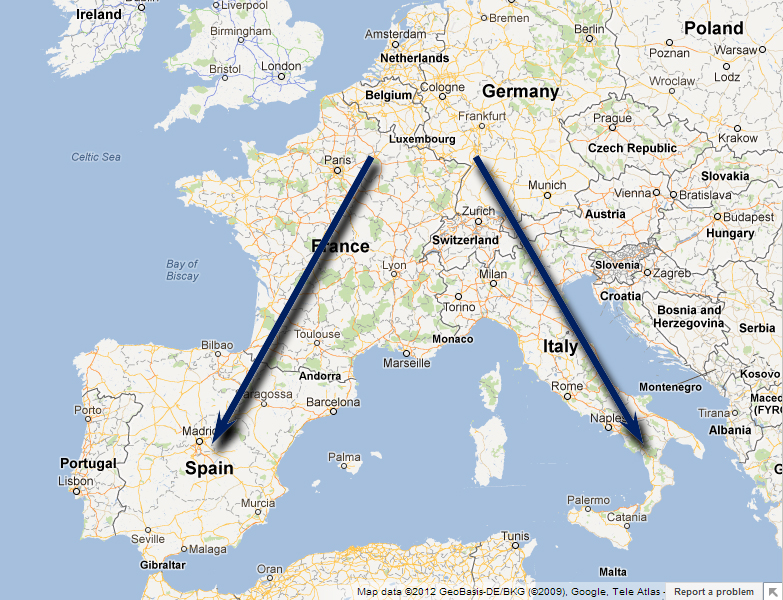
   We can’t assume that the Vandals were genetically homogenous.  At various times they were associated and allied with the Alani and Suevi tribes.  Any DNA trail found, could just as easily belong to a group along for the ride.  I started researching all these haplogroups along the Vandals’ 400-year migration route to find a DNA footprint. The key datasets included records from Sicily, Sardinia, Tunisia, Spain, France and Germany.  These locations create a triangle of migratory patterns, clockwise, counterclockwise and dispersion.  If these sets have evidence of Vandals DNA, there should be a counterclockwise flow around Europe and a west to east flow across the Mediterranean.  Immediately I was able to remove haplogroup N from the running, there were no records.


   I have to admit that going into this project I thought that the Scandinavian I1 haplogroup would be my most likely suspect.  I had built a picture in my mind that all the Germanic tribes had come out of Scandinavia.  I researched this group first, looking for genetic flow across time. Usually I work with an individual record and trace backward through time.  For this project, I’m analyzing large groups in multiple datasets.  At a high level I’m searching for DNA that has migrated from Germany, through France and Spain to Tunisia and then to Sicily and Sardinia.

   Using TMRCA (time to most recent common ancestor) and my own TribeMapper techniques, I was able to identify that the Scandinavian I1 haplogroup formed a parallel dispersion pattern.  The y-DNA genes flowed from Germany down into the Italian peninsula and into the Iberian Peninsula at roughly the same time.  Haplogroups G2a and R1a also fall into this category of dispersion.  These DNA records don’t fit the pattern of the Vandals’ migration.

I1, G2a & R1a migration pattern

   The R1b Celtic-Iberian haplogroup proved more difficult to decipher.  This is a major group in Europe, representing over 60% of the Western European population.  For over 10,000 years, there has been a strong flow out of the Iberian Peninsula toward the British Isles, Germany and Scandinavia.  Detecting a counterflow against that tide is problematic.  The apparent direction of migration across the datasets I researched shows a clockwise pattern out of Spain, into France and Germany and then down the Italian peninsula.  R1b doesn’t look like our Vandals, but I’m going to reserve judgment until better analysis tools are developed.

R1b migration pattern

   I’ve left haplogroup I2a, the Danubians, for last because they have the best correlation to the Vandals.  Their genetic migration does show a counterclockwise flow from Germany, through France and Spain and into Sicily and Sardinia.  This DNA can be found in the historic Vandali regions of Aquitaine, Galicia, Lusitania and Andalusia.  Haplogroup I2a is a dominant Germanic group associated with the Danube River, giving them the nickname Danubian.  This matches the Vandals earliest historical references.

I2a migration pattern

   Myles Standish of Mayflower fame was also haplogroup I2a.  Standish is not closely related to the DNA that I am chasing.  His tribe and the Vandals parted ways over 5,000 years ago.

   Have I found the Vandals, Alans or Suevi?  So far, I have been looking at the past 2,000 years.  If I expand the datasets and research back further in time, additional patterns appear.   The DNA takes me to Georgia, Armenia and Iran.  The timing and the location of these records put us in the historic Alani homeland on the Asian steppe.  The Huns were also responsible for driving the Alans west into Europe around 300 AD.  I’ve been looking for Vandals and I’ve found the Alans instead.


   The I2a1 tribal haplotype that I have identified has remained relatively unchanged for thousands of years and has allowed me to follow a migration in and out of Asia and across Europe.  I cannot say that I have found the DNA of all the Alans or that the Alans were only haplogroup I2a.  The correlations that I have made are based on records currently available and it is impossible to say what additional future DNA records may reveal.

   The mystery of the Vandals remains a mystery.  I now have an unexpected peek at a piece of the Alani origins and migrations.  When clients want to know more about their DNA, I can check them against this data.  I’d love to be able to get to a point where I can tell folks - ‘Hey, you’re a Visigoth!’  One of the biggest parts of DNA testing beyond finding family, is connecting ourselves to history, knowing that your ancestors played a role.

© Origin Hunters & OriginsDNA

Friday, September 7, 2012

Your Father's Father


Deep Into DNA*


   Raise your hand if you’d like to know more about your surname and your father’s ancestry.  I’m raising mine!

   Most of us live in a patrilineal society.  The wife and the children take the surname of the husband.  We can’t help but to associate with our father’s family, his clan.  The males in the family will inherit the Y chromosome virtually unchanged, though genetically, we can only attribute a small fraction of our overall DNA to that patrilineal line.  Psychologically though, 50% of our ethnic identity comes from dad.   


   We have all tried traditional genealogy for our father’s line.  Some of us go back a couple of generations and some of us have researched a dozen generations.  A few of us are adopted and know nothing about our paternity.  Y-DNA testing has benefits that aid a genealogist in all these situations...

...continued at The In-Depth Genealogist with a free membership.

*The Deep Into DNA article series is published each month in The In-Depth Genealogist Newsletter and will demystify genetic genealogy and make sense out of DNA testing terminology.  Each month we will talk about the types of tests available from major labs and show relevant examples on how to use DNA in your genealogy research.

#gDNA