Wednesday, July 4, 2012

Attila, Native Americans and DNA: A Hunny Story


   Recently at a conference, I was talking to some folks about DNA and the migration of tribes based on haplotypes.   A question came up, "What about the Huns?"  I had to answer that I had never looked into the Huns. That night I started looking for evidence that the Huns left a genetic footprint.

   I usually take the DNA of an individual and work backwards to find their origins.  In this case, I started with the origins and tracked forward in time.  The Huns were a nomadic tribe of people that arrived from eastern Asia around 150 AD.  They built a European empire that lasted until 469 AD.  The height of the empire was under the reign of Attila.

   The Huns were not a homogeneous group.  They integrated those that they conquered.  The Alani and the Ostrogoths were a few of the assimilated groups.  Their DNA would have been eastern European, perhaps R1a, G2a, I1 or I2 and a minority proportion, but the core and the majority of the Huns, based on historical reference, would have been East Asian.

   By the end of the Hunnic Empire, the Huns had spent over 300 years, 12 generations, in Europe.  Unlike the later Mongol invaders, the Huns had no Asian home to return to.  They, in turn, were assimilated into the cultures they once ruled and left descendants across Europe.

   Most likely the Huns were from eastern Asian origins.  That limited them to haplogroups C – ‘Mongol’, D – ‘Tibetan’, N – ‘Han/Finn’, O – ‘Manchurian’ and Q – ‘Altaic’.  The ethnic descriptions that I’m using are overly simplistic, just enough to give you a feel for the possible cultures present.   I surveyed DNA record sources for Russia and Europe, looking specifically for these haplogroups.  Groups D and O were isolated individuals, easily attributed to Silk Road travelers who settled in Europe.  Group C was predominantly C3 and related to the later Mongol invasion.  N was either heavily Finnic or a few isolated Siberian individuals.  Q was a different story completely.


   Haplogroup Q has origins in Siberia, most likely north of the Altai Mountains.  Q is also the origin of the Native Americans.  The majority of the Native America haplogroup is Q1a3a.  What I found was a significant Q1b and Q1a2 population in Eastern Europe.  When I map the Q1b genetic footprint using TribeMapper they fall exactly north of the Danube River and east of the Rhine.  This corresponds to the territory of the Hunnic Empire.  The Q1a2 group maps to Hungary, the royal seat of the empire.

   These Q1b and Q1a2 are close-knit tribes each with common ancestry within the last 2100 years.  The timing of their common ancestry and their geographic footprint make a strong argument that these two Q groups were the genetic core of the Hun invaders.

   A few caveats.  Not every European in haplogroup Q is a Hun.  There is a population of Q1a3a, a closer relation to Native Americans, living in Sweden that doesn't correlate.  Not every Hun is a Q, there are bound to be some other groups mixed in like the isolated N individuals as well as the folks the Huns picked up along the way.

   When we think of the Huns, probably the first person who comes to mind is Attila.  Attila was the second to last ruler of the Huns at the height of the empire.  He died in 453 and the empire crumbled in 469 AD.  There is no evidence to say that Attila fits into either the Q1b or Q1a2 group.  If I had to pose a theory, I would say that Attila is Q1a2, part of the royal class of Huns living in Hungary.

    The Huns (Q1a2 & Q1b) and the Native Americans (Q1a3a) share a common Asian ancestor around 18,000 years ago, most likely from the Altai Mountain region.  Not all of the ancestral Q1a3a traveled to the new world.  Some remained in the old world and are found across Siberia and into Scandinavia.  If you live in the Americas and you have been tested as a Q, don’t automatically assume that you are Native American.  Get a deep clade SNP test for confirmation.

   The combined evidence of DNA, geography and history leads to the conclusion that at the end of the Hunnic Empire, the core East Asian Huns assimilated into the eastern European cultures.  They left behind a strong genetic footprint in the same territory that they historically inhabited.  The next time I’m asked, “What about the Huns?”  I can point to Europe and say, “They’re still there.”

Friday, June 15, 2012

Myles Standish: Mayflower DNA


   My genealogy has one Mayflower passenger, Stephen Hopkins.  Seven other passengers are cousins in one manner or another, Doty, Howland, More, Mullins, Standish, Warren and Winslow.  Twenty-four of the Mayflower families have living descendants.  I have collected the y-DNA records for fifteen of them. (For more on this process watch this short video) It was no surprise to find eight R1b Celts and four I1 Scandinavians among them.  But, the three I2a Balkans intrigued me.

   The one name that stood out as I2a was Myles Standish.  Every first grader knows that name.  My first thought was that Myles was descended from a member of the Roman Legions.  Perhaps he was a Scythian or Sarmatian.  I needed to identify the Standish family tribe and when they arrived in England.   If I was lucky, I’d be able to bracket the immigration of his ancestor to the 1st or 2nd century, the height of the Roman conquest.

   As the DNA records started to compile using TribeMapper® analysis, an initial pattern developed showing historic habitation on either side of Hadrian’s Wall.  This was the beginning of a great migration story and potentially the end to the dispute of Myles Standish’s origins.  Researchers have placed Standish’s birthplace as either Lancashire or the Isle of Man.  Based on the data, Lancashire emerges as the most likely location.  There was no genetic indication that the Isle of Man was a possibility.

   If Standish’s ancestors had been conscripted into the Roman Legion, then I would expect their migration pattern to appear scattered like a diaspora.  Fathers and brothers and their descendants would be spread across the Roman empire.  There would be no focus for the data points representing the period 2,000 years ago.

   The actual data points told a different story.  They remained focused.  At the end of the last ice age, about 10,000 years ago, Myles Standish’s ancestors were living in the Balkans.  As the ice receded, they journeyed up the Danube River, a major migration highway, until they reached the upper Rhine.  The upper Rhine was a Neolithic way station for many tribes coming up the Danube or out of Iberia.  The area served as a stopover before continuing over the Alps or down the Rhine.  The Standish tribe chose to follow the Rhine down to the North Sea.


   Between 2,000 and 3,000 years ago, Standish’s ancestors crossed into England and made their way up the Thames to its source.  My theory is that they were pushed ever westward by successive waves of immigrants.  They found Wales to be well populated already and ventured north to where we find the most recent genetic evidence, in Lancashire.

   My initial theory that Standish’s ancestor was brought to England as part of the Roman Legion, to reinforce the troops at Hadrian’s Wall, was wrong.  It is always good to have a theory to work toward, but don’t let preconceived ideas get in the way of new evidence.  Now that we know that Standish’s origins are pre-Roman we can consider that his family is one of the native tribes of Britain.  The most likely Lancashire tribe would be the Setantii, which is a sub-tribe of the Brigantes.

   Each one of our ancestors has a unique migration story to tell.  Their travels overlap with events that we have read about in history books.

   Where did you come from?

© Michael R. Maglio and OriginsDNA

Monday, June 11, 2012

Who's Who in the DNA Zoo


   When I talk to folks about y-DNA, I like to give the haplogroups an ethnic identity.  Rather than just saying that they are R1b, I also talk about their Western European or Celto-Iberian deep ancestry.  This helps them associate their DNA in a historical and geographical context.  It is important to understand that your nationality is just the outside of the onion, with many more ethnic layers beneath.


   I’ll pick on England for second, because they’re an island.  Roughly 10,000 years ago, nobody lived in England.  It was still recovering from the Ice Age.  Over the past 10,000 years, England has seen wave after wave of immigrants and invasions.  It’s only been the last 2,000 years that we can label these new comers as Romans, Vikings, Anglo-Saxons or Normans.  If you consider yourself English, think again.  What is that next ethnic layer?

   If you want to know the answer, I suggest taking a DNA test to get your ancestral origins.  The approximate cultural identities that I use for y-DNA are:

  • C3 - Mongol
  • E1b – Greek / Egyptian
  • G2a – Caucasus / Etruscan
  • I1 – Scandinavian
  • I2 – Balkan / Danubian  
  • J – Phoenician / Semitic
  • N1c – Finn
  • Q1a – Siberian / Native American
  • R1a – Balkan / Slavic
  • R1b – Celtic (most common in Europe)

   I see these haplogroups consistently in Europe.  There are many more, worldwide.  Even these ethnicities are too generalized.  Throughout history, the R1b and I1 folks have shared geography from Iberia to Scandinavia.  It may be easy to describe someone as Celto-Scandinavian, but it is difficult to say Scandinavian-Iberian.  Location based naming conventions are tough to use for nomadic tribes.

   Perhaps you are English and have taken an autosomal DNA test.  As part of the at-DNA test, you get an ethnic population distribution.  It might say that you are 100% Scandinavian.  Now you have peeled back one more layer of your ethnic onion.  What flavor of Scandinavian are you?  This is where y-DNA can help place you in either the R1b, I2, N1c or even Q1a group.

   You could find out that you are R1b Scandinavian (with Celto-Iberian roots) and that more than likely your ancestors entered England as part of the Anglo-Saxon invasion.  One more layer peeled back.  I know that R1b men were among the Anglo-Saxons.  That doesn’t mean that they were a homogenous group.  Perhaps you are more Angle than Saxon or even Jute.

   Many of these nomadic haplogroups traveled the same river highways and lived in the same regions.  Today the genetic groups are thoroughly mixed in every country.  It is difficult to pick a time in history when we weren’t mixed.  History books are full of the great battles between nations.  Where is it written that two tribes co-existed, worked together and built a new common heritage?

   I can count Italian as part of my heritage, with roots in the mountains outside of Benevento.  That definition of me only has a 150-year history.  Prior to 1860, Italy was not a unified country.  3,000 years ago, my ancestors were living on the north side of the Alps in what is now Switzerland.  That doesn’t make me Swiss or does it?  7,000 years ago, my ancestors lived along the Danube River.  Now I’m Danubian.  Before that, we were in the Caucasus Mountains.  I sense a mountain theme going on here.  Perhaps I should call myself Caucasian?  My y-DNA haplogroup is G with origins in the Caucasus and my autosomal test indicates a close relation with the Adyghe or Circassian tribes of current day Russian Georgia.  A rough translation of the word Adyghe means ‘mountaineer who lives near the sea or between two seas’.  The Italian peninsula must have made a great home away from home.

   I could continue to peel back the layers of my ethnicity.  Genetically we could all say that we are African.  Who we really are and what culture we associate with has gotten a bit more complex.  My y-DNA is just a fraction of my identity.  I enjoy the music of Scottish bagpipes while drinking Irish beer or eating a nice slice of lasagna with a glass of German wine.  I have a craving to hike in the mountains, go figure.

Friday, June 8, 2012

DNA at the Genealogy Field Day

The Massachusetts Society of Genealogists presents -


When: Saturday, June 9, 2012, starting at 1:30PM

Where: Framingham Public Library, 49 Lexington St., Framingham

(free & open to the public - bring a friend)

Join Jeff Carpenter and Mike Maglio at the DNA table to talk about all your genetic genealogy questions.

Other Field Day topics include:
The 1940 Census
Scanning Demonstration - Flip Pal
Genealogy Mapping Tools
iGoogle
Scandinavian Research
Ask the Expert
Web Demonstrations
and more...


Wednesday, June 6, 2012

Marie Antoinette: DNA Family History


   When we use DNA to research our family history, we have the potential to uncover quite a bit of information.  We could find living cousins, lost connections and deep ancestral origins.  There is also geographic information associated with your DNA.  When you start comparing your DNA to your Clan and your Tribe, you can map your recent old world origins and your migrations.

   You are not limited to your own DNA as you are researching.  As we work on our traditional genealogy, we may find famous ancestors, a Mayflower passenger here or a President there.  If you are descended from them then you can bet that hundreds of other people are also.  Many times one of those hundreds has had their DNA tested to confirm their relationship to that famous ancestor.  You can use that published data to add to your family history.

Source: Wikimedia Commons

   Let’s look at Marie Antoinette, while she has no living descendants, she makes a great example.  Tests from a lock of her hair and from her son’s preserved heart show her mitochondrial DNA to be haplogroup H, the most common group in Europe.

   Marie Antoinette’s results - HVR1 - 16519C and HVR2 - 152C, 194T, 263G, 315.1C

   Marie Antoinette’s maternal line has been documented back 25 generations to the 1100s.  You could still be related to her through this Germanic line of women.  There are twelve exact HVR1/HVR2 matches for Marie Antoinette on Mitosearch.org.  Even with an exact match, that common ancestor lived over 625 years ago, in the 1300s or earlier.

   On paper, Marie Antoinette’s ancestry goes back to the 1100s in the Holy Roman Empire (modern day Germany).  DNA can take us further.  One theory shows a correlation between HVR2 marker 152C and the Goth barbarian tribes.  The Goths were in no way a homogenous genetic group as they grew through mergers and acquisitions.  To say that one DNA marker defines a mixed group like the Goths may be hard to prove.


   If we look at the geographic data associated with Marie Antoinette’s maternal tribe, a pattern starts to emerge.  Take all the DNA records available, matches and close matches.  With each close mismatch, we can step backwards in time in roughly 625-year increments.   TribeMapper® analysis shows a genetic flow of ancestors from Scandinavia down through the Germanic heartland.  The timing of this flow, from 2200 to 1300 years ago suggests a connection to the Goth migrations.  While this is still not definitive proof, it is an additional element that could be used to build a case that Marie Antoinette was a Goth descendant.

   This is an example of the geographic data that can be harnessed from mitochondrial DNA.  The results with mtDNA tend to be more macro as there is less variability, which leads to less timeline resolution.  Y DNA has more variability and will produce maps in greater detail.  Our unique Tribal DNA will tell its own migration story and help tie us to history.

© Michael R. Maglio and OriginsDNA

Tuesday, May 22, 2012

A Genealogy Twofer


   Two family history articles for the price of one (still free).

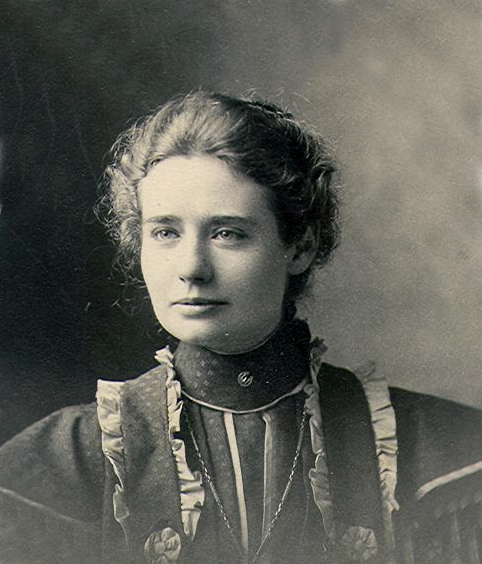
   Florence Jane Ovens was born in the London Borough of Wandsworth in 1872.  Along with her father, step-mother and brother, she emigrated to the United States around 1880.  She graduated from the Hyannis State Normal School (later the Hyannis State Teachers College) in Hyannis, Massachusetts.  By 1900, she was teaching in the Falmouth school system.  She also taught in the Somerset, MA, Clinton, MA, Chester, NH, and York, ME schools between 1900 and 1920.

Florence Jane Ovens (1872-1955)

   In the 1920s, Florence moved to New York City and in 1923 filed for naturalization.  By 1928, she had met Elizabeth ‘Bessie’ Locke.  Until the time of Bessie’s death in 1952, they were constant companions.  Bessie Locke was the Founder and Director of the National Kindergarten Association and Florence became the Executive Secretary and Editor.  Their goal was to bring public kindergarten to all the nation’s children at a time when only 1 in 10 children received pre-elementary education.

   At the invitation of President Roosevelt’s Advisory Committee on Education, Bessie and Florence wrote The Kindergarten in the United States in 1937.  They were never able to get their kindergarten bill through Congress.  Instead, they focused their energy at the state level.  In their lifetime, they personally helped create over 3,000 kindergartens.

   I’m writing about Florence because she is my wife’s great aunt. Florence was also instrumental in helping me figure out how my wife’s great-grandfather arrived here from England.

   We all hit various size brick walls when we research.  No amount of research experience can ever eliminate running into a brick wall.  I will usually turn to other genealogists and ask how they might have gotten around my particular type of roadblock.

   I was able to find my wife’s great-grandfather, William J Ovens, in England in the 1871 census and then again in the 1885 Dedham, MA city directory.  I could find nothing in between.  William did become a citizen, but his naturalization papers shed no light on his arrival.  Like a physical brick wall, if you follow it sideways far enough you can usually get around it.  Whenever possible, I start searching sideways, widening my research by looking at sibling, cousins and children.

   While looking at William’s daughter, Florence Jane Ovens, I found an amazing woman dedicated to education and I found her naturalization papers.  Her papers told a much more illuminating story than her father’s did.  The family had crossed from Canada after living in Montreal for nearly a year.

   I use Ancestry.com.  The have a very large collection of records and even the best database query never returned a result for a Canadian border crossing.   Like many companies with an international presence, Ancestry will help narrow the volume of data presented to you by giving you the localized information first.  If you are on the US site, you get US records first.  If you are on the UK site, you get the UK records first.  Depending on your subscription, you may not even see beyond the local data.  I have the international version, which should allow me to see the Canadian records.  From the US site, those Canadian records weren’t rising to the top.  I logged into the Canadian site – www.Ancestry.ca.  Did you know you could do that?  There are eight international versions, including US, UK, Canada, Australia, Germany, Italy, France and Sweden.  By logging into the alternate site, the records I was looking for rose to the top.  After changing my point of view, I now had passenger records and border crossings for the Ovens family.  Thank you Florence.

   Ancestry is not the only company that has different sites.  Google has a unique site for nearly every country.  Like Ancestry, Google will push the local results to the top of a search.  If you are doing any kind of foreign genealogy research, you need to try this.  Create a search on Google.com, then do the exact same search on Google.it or Google.de or Google.co.jp.  Naturally, it helps to know the language or to use the Google Chrome browser and let it translate for you.

   Sometimes you need to change your point of view.  Get a fresh perspective.  Clear a new path.  [Insert your metaphor here]

   Remember to research sideways when you hit a brick wall.  There are many great stories from our extended family members.  One of those folk may hold the key to what you are looking for.


Tuesday, May 15, 2012

What's Happening: IDG & MGC

I have two great things to announce today.


My first column about DNA was published today in The In-Depth Genealogist.  You can subscribe to the newsletter here - In-Depth.  You can read my column here - The Library of You.

The 2012 Massachusetts Genealogical Council Annual Meeting & Seminar registration is now available here - MGC.  I will be presenting the topic - Armenian Americans: Diaspora, Migration & Genealogy.

Wednesday, May 2, 2012

The Autosomal Match Game


   Don’t get me wrong.  Autosomal DNA testing is a very valuable tool.  A match has the possibility of breaking through some very significant genealogical brick walls.  It’s important to understand what a match means or doesn’t mean.

   In a nutshell, we all have 46 chromosomes, 23 from mom and 23 from dad.  Two of those chromosomes are the sexy kind, X and Y.  We’ll ignore those for now.  In an autosomal test, the DNA sequences in your chromosomes are compared against everyone in the testing company’s database.  The goal is to find long matching sequences.  Depending on how long the sequences are and the total number of matching sequences, a calculation predicts the cousin relationship.

   Now here is where things get dicey…

   Take two full siblings (not twins).  At first glance, you might think that genetically they are a 100% match.  Dad gives these two siblings 23 chromosomes each, half of his DNA.  It’s not necessarily the same 23 chromosomes.  Mom does the same.    Let’s look at the two extremes.

   Imagine mom’s DNA as two chunks of 23 chromosomes each – A & B.  Dad has two chunks also – C & D.  Mom gives each child chunk A and dad gives each chunk D.  Both children will have A & D and will be exact genetic matches.


   What if mom gave one child A and one child B.  Then dad gave one child C and one child D.  The full siblings would be A & C and B & D, showing no match at all.  The truth is that a full sibling match will exist on a continuum somewhere in between.


   The probability that a sibling match would be 0% or 100% is extremely low.  Cousin matches are a different story.  In a perfect world, two 1st cousins could share 25% of their DNA.  Two 2nd cousins might have 1/8, 3rd cousins – 1/16, 4th – 1/32 and 5th cousins – 1/64 – a little more than 1% shared DNA.  The possibility of two cousins not sharing DNA or not sharing a long enough sequence to make a match gets higher.

   In my family, two Scottish brothers married two German cousins.  I am the grandson from one of these unions.  I have a cousin who is the grandson from the other marriage.  We are both 2nd cousins and 3rd cousins.  It is possible that we share 1/8 plus 1/16 for a total of 3/16th.  That much shared DNA could be reported on a test as being 1st cousins.

   The autosomal match game is not a perfect world.  If you don’t get a match and you think you should have, then test different cousins.   Adding more DNA samples could give a new set of results.  If you do get matches, the degree of the relationship can help set a starting point in looking for that common ancestor.

   DNA is just one of many tools we have as genealogists.  In the case of autosomal testing, DNA is just the beginning.  It will take traditional genealogy to get you to the prize.

#gDNA

Monday, April 30, 2012

Social Genealogy: The Webinar

If you missed my talk on Social Genealogy this month, you can now see the recorded webinar.

http://vimeo.com/40376335

Presented at the April 2012 Middlesex Chapter meeting of the Massachusetts Society of Genealogsts, Inc.

I look at social media tools and how to use them like a genealogy detective. Using social media and building a strong network are a valuable part of your genealogy toolbox.

Thursday, April 5, 2012

Social Genealogy: Finding Your Cousins

   It's not what you know and it's not who you know, it's how big is your network.


   Join us on April 14th at 1:30 at the Framingham Public Library as the Massachusetts Society of Genealogists host and I present Social Genealogy: Finding Your Cousins.

   We will look at social media tools and how to use them like a genealogy detective.  Using social media and building a strong network are a valuable part of your genealogy toolbox.

   If you can't make it out to Framingham then join us for the free live webinar.  Register here.

   Let's get social!